HE WAS DANCING WITH HIS LOVER, BUT HIS STUNNING WIFE STOPPED THE GALA COLD.013
HE WAS DANCING WITH HIS LOVER, BUT HIS STUNNING WIFE STOPPED THE GALA COLD
He brought his pregnant mistress to the charity ball and introduced her as “the future” while his wife stood ten feet away holding the donation speech she had written for him.
The ballroom went quiet, not because Rita cried, but because she smiled.
By sunrise, Cain Santana would learn that the woman he had erased had designed the foundation his empire was standing on.
The Bellagio ballroom shimmered like a mirage built from money and light.
Crystal chandeliers floated above the room in glittering tiers, scattering gold over marble floors, white orchids, black tuxedos, and women in gowns that moved like poured wine.
Beyond the tall windows, the Las Vegas Strip burned bright against the desert night, a fever of neon and glass, every hotel pretending that desire could be permanent if only the lights were expensive enough.
Rita Morales stood near the edge of the stage with a folder in her hand and a smile she had practiced in the mirror of a hotel bathroom for eleven minutes.
Her dress was ivory silk, understated, architectural, cut along clean lines that made her look taller than she felt.
Her dark hair was pinned low at the nape of her neck.
Her lipstick had not smudged, though she had bitten the inside of her cheek so hard during the drive over that she could taste blood every time she swallowed.
The speech in her folder was for Cain.
Her husband.
The man the Nevada Children’s Foundation had chosen to honor that night for “visionary philanthropy and community leadership.”
Rita had written every word of it.
She had written about his childhood in North Las Vegas, his first construction loan, the scholarships he claimed had changed his life, the foundation they had created together to fund design programs for immigrant students and children aging out of foster care.
She had written lines that made him sound generous, disciplined, noble.
She had removed anything too self-congratulatory because Cain liked applause more when it looked like humility.
She had been doing that for six years.
Softening his rough edges.
Correcting his tone.
Rewriting the things he said so the world would hear what he meant to perform, not what he truly was.
Then the ballroom doors opened.
At first, Rita did not turn.
She saw the change move through the room before she saw him.
Conversations thinned.
A few heads angled toward the entrance.
Someone near the bar gave a tiny, delighted gasp, the kind people release when scandal walks in wearing expensive shoes.
Rita knew before she looked.
Cain Santana entered like a man who believed every doorway belonged to him.
Tall, silver at the temples, impossibly composed in a black tuxedo tailored so well it seemed less worn than engineered around him.
Beside him, clinging to his arm, was Sophia Restrepo, twenty-six years old, luminous in emerald satin, one hand resting on a visibly pregnant belly.
Not hidden.
Not ashamed.
Displayed.
Cain’s hand covered Sophia’s at her stomach with the careful tenderness of a man presenting proof of a future he had already chosen.
For one second, Rita heard nothing.
Not the quartet.
Not the clink of glasses.
Not the soft rustle of expensive fabric.
The entire room collapsed into a single image: her husband’s fingers laced over another woman’s unborn child while Rita stood there holding his speech.
Then Marcus and Diana Williams approached Cain with open arms.
Diana kissed Sophia’s cheek.
Marcus clapped Cain on the shoulder.
Someone laughed.
And Rita understood that the betrayal had not only happened behind her back.
It had been accommodated.
Discussed.
Folded politely into the social calendar.
Her humiliation had become a seating arrangement.
Cain saw Rita just as an event coordinator whispered, “Mrs. Santana, we’re ready for you in two minutes.”
His expression changed so quickly most people would have missed it.
Cain had spent years teaching his face to obey him.
Investors trusted that face.
Bankers extended credit because of that face.
Politicians smiled beside that face in photographs.
But Rita had once loved him deeply enough to know the smallest failures in his control.
Shock.
Annoyance.
Calculation.
Then the mask returned.
He walked toward her with Sophia beside him.
“Rita,” he said, as if greeting a guest he had not expected but could manage.
The humiliation should have made her tremble.
It did not.
Something inside her had gone very still.
“Cain,” she replied.
Sophia’s eyes swept over Rita, taking in the dress, the folder, the wedding ring still on her hand.
Her smile was soft, almost apologetic, and worse than cruelty because it carried the arrogance of a woman who believed she had already won.
“I hope this isn’t uncomfortable,” Sophia said.
Rita looked at her.
“It is,” she said.
“But not for the reason you think.”
Sophia blinked.
Cain’s jaw tightened.
“Rita,” he murmured, leaning closer.
“Not here.”
Those two words carried six years of command.
Not here meant do not embarrass me.
Not here meant swallow what I did and protect the room from consequence.
Not here meant your pain is less important than my reputation.
Rita lowered her eyes to the folder.
On the first page, Cain’s name was printed in bold above a speech that had taken her three nights to perfect.
Three nights while he said he was in Phoenix meeting developers.
Three nights while Rita sat alone at the kitchen island, reheating soup she did not eat, shaping language around the illusion of a man who no longer came home smelling like home.
She closed the folder.
The small sound was lost under the quartet, but Cain heard it.
“Rita,” he warned.
She smiled again.
That was when the room began to notice her.
Not because she raised her voice.
Not because she made a scene.
But because everyone in that ballroom understood expensive silence.
They knew the weight of a pause when power shifted inside it.
The event coordinator touched her earpiece, pale with confusion.
“Mrs. Santana? The chairman is introducing Mr. Santana now.”
Across the room, the foundation chairman had already stepped onto the stage, beaming beneath the golden light.
“Ladies and gentlemen,” he began, “tonight we honor a man whose generosity has changed the lives of thousands of children across Nevada—”
Applause started.
Cain looked away from Rita and smiled toward the stage.
Sophia adjusted her posture, pressing closer to him.
The chairman continued, “A builder not only of skylines, but futures.
Please welcome our honoree, Mr. Cain Santana.”
The ballroom rose.
Hands clapped.
Cameras flashed.
A dozen wealthy mouths shaped admiration.
Cain turned toward Rita one last time, his eyes dark and cold.
Behave.
He did not say it.
He never had to.
Then he took Sophia’s hand and led her up the steps.
Rita remained below the stage.
Cain accepted the glass award with both hands.
He kissed Diana Williams on the cheek.
He shook Marcus’s hand.
He looked out at the ballroom like a king surveying land already paid for.
“Thank you,” Cain said into the microphone.
“This foundation has always been personal to me.”
Rita almost laughed.
Personal.
That was Cain’s talent.
He could steal your labor, your warmth, your years, and still make theft sound like destiny.
He spoke beautifully, of course.
Rita had taught him where to pause.
How to look down after mentioning poverty.
How to soften his voice when talking about children.
He used phrases she had written on napkins, in margins, in the notes app on her phone while waiting outside boardrooms where men called her “Cain’s wife” instead of co-founder.
Then Cain turned and reached for Sophia.
The ballroom inhaled.
Rita watched him guide her beside him, emerald satin glowing beneath the chandeliers.
Cain placed one hand at Sophia’s back.
“And tonight,” he said, “I want to acknowledge someone very special.
Someone who represents the next chapter of my life.
Sophia Restrepo.”
A murmur moved through the room like a match touching dry paper.
Cain smiled.
“She is carrying my son.”
The words struck harder than any slap because he delivered them with pride.
Not apology.
Not shame.
Pride.
Sophia lowered her head as if modesty could perfume betrayal.
Cain continued, “I know this may surprise some people.
But life changes.
Families evolve.
And sometimes the future arrives before the world is ready to understand it.”
The room did not clap.
No one knew where to put their hands.
Rita felt hundreds of eyes flicker toward her.
Pity from women who had once envied her.
Hunger from men who loved watching another man survive disgrace.
Panic from donors whose names were attached to Cain’s.
Cain looked directly at Rita.
There it was.
The challenge.
He had brought Sophia not only to reveal her, but to force Rita into silence publicly.
To make her choose between dignity and destruction.
To make her stand there like beautiful furniture while he rewrote their marriage under chandeliers.
The chairman hurried toward the microphone, laughing too loudly.
“Well,” he said, “what a joyful announcement.”
It was the wrong word.
Joyful.
Something in Rita’s chest opened, not like a wound, but like a door.
She stepped forward.
At first, only the event coordinator saw her move.
“Mrs. Santana?” the woman whispered.
Rita climbed the stage steps.
One.
Two.
Three.
Her heels made no sound on the carpeted risers, yet Cain turned as if he had heard thunder.
“Rita,” he said softly, away from the microphone.
“Don’t.”
She took the microphone from the chairman’s hand.
She did it gently.
That made it worse.
The chairman surrendered it because powerful rooms are trained to obey calm people.
Rita faced the ballroom.
For a breath, she said nothing.
The chandeliers glittered above her.
The cameras pointed.
Sophia stood two feet away, one hand on her stomach.
Cain’s award caught the light like ice.
Rita opened the folder.
Cain’s shoulders eased slightly.
He thought she was going to read the speech.
He thought obedience had survived humiliation.
“My husband,” Rita began, “was supposed to deliver these remarks tonight.”
A few uneasy chuckles trembled and died.
“I wrote them for him.”
Cain’s smile froze.
Rita looked down at the page.
“It begins, ‘Good evening, friends.
I stand here humbled by an honor I do not deserve alone.’”
She lifted her eyes.
“That part was true.”
The room went silent again, deeper this time.
Rita turned the page.
“I spent six years helping build the Nevada Children’s Foundation.
Not as Cain Santana’s wife.
Not as a decorative signature on gala invitations.
As the person who drafted its first grant application at our dining table when Cain said children’s programs were ‘bad optics unless they had corporate partners.’”
Cain whispered, “Rita.”
The microphone caught it.
Everyone heard.
She did not look at him.
“I found the architects willing to donate hours.
I recruited the first mentors.
I reviewed the scholarship essays.
I visited foster homes.
I sat with children who cried because they had never owned a desk, then came home and wrote speeches so my husband could be applauded for giving them one.”
A woman at table fourteen pressed her napkin to her mouth.
Sophia’s smile had disappeared.
Rita’s voice stayed calm.
That was what made it terrifying.
“I also kept records.”
Cain’s face changed.
Not much.
Enough.
Rita placed the folder on the podium and opened the inner pocket.
She removed a slim black flash drive and held it up between two fingers.

“The foundation’s independent auditors received copies of these documents at six o’clock tonight.
So did the attorney general’s office.
So did the IRS criminal investigations division.
So did three newspapers.”
A glass fell somewhere in the ballroom and shattered.
Cain took one step toward her.
“You don’t know what you’re doing.”
Rita finally looked at him.
“I know exactly what I’m doing.”
That was the moment the ballroom understood the gala was no longer a celebration.
It was a trap with orchids.
The big screen behind the stage flickered.
The sponsor logo vanished.
A spreadsheet appeared.
Rows of numbers.
Vendor names.
Transfers.
Shell companies.
Cain turned slowly toward the screen.
Rita spoke into the microphone.
“For years, money pledged for children’s housing programs was rerouted through consulting firms controlled by Santana Development.
Renovation funds disappeared into luxury properties.
Scholarship accounts were drained and replaced before annual review.
Some donations were repaid with other donations.
A circle made to look like generosity.”
Marcus Williams stood abruptly.
“Turn that off.”
No one moved.
The AV technician at the back of the room stared straight ahead, hands folded, as if he had been waiting for this all night.
Cain’s lips barely moved.
“You think they’ll believe you?”
Rita clicked the remote.
A scanned document appeared.
Then another.
Then a recording transcript.
Then a photo of Cain in a private dining room with Marcus and Diana Williams, signing papers beneath a wine rack.
“This is not about belief,” Rita said.
“It’s about evidence.”
Sophia turned to Cain, panic sharpening her voice.
“Cain?”
He ignored her.
He only looked at Rita.
The hate in his eyes was intimate.
Married hate.
Hate that knew where the spare towels were kept and how she took coffee and what song played at their first dance.
“You ungrateful little girl,” he said.
The microphone caught that too.
A soft gasp rippled through the room.
Rita almost smiled.
Not with victory.
With sadness.
Because there he was.
Finally.
The man underneath the speeches.
“The first time you called me that,” Rita said, “was when I asked why the scholarship checks were delayed.
The second time was when I found the invoice for the Phoenix penthouse.
The third time was last month, when I told you I wanted children.”
Cain’s face went pale.
Sophia looked down at her belly.
Rita let the silence settle.
Then she said, “You told me I was too old to start over.”
She was thirty-seven.
The words moved through the women in the room first.
Rita could feel it.
A shared flinch.
A collective memory of all the ways women had been measured, dismissed, traded for newer skin, then expected to smile graciously at the exchange.
Cain leaned toward the microphone, trying to recover.
“My wife is emotional tonight,” he said.
“This is a private marital matter, and she is twisting business records she does not understand.”
Rita nodded once.
“I thought you might say that.”
She clicked again.
The screen changed.
A video appeared.
Cain’s office.
Cain’s voice, unmistakable.
“If Rita ever finds the Restrepo transfer, bury it under the after-school building budget.
She signs whatever I put in front of her.”
The room went dead.
Rita heard someone sob softly.
On the screen, Cain laughed.
“By the time she understands, she’ll be too humiliated to fight.
Women like Rita don’t burn houses down.
They sweep ashes.”
The video stopped.
Rita stood with both hands resting lightly on the podium because if she did not hold something, she thought she might fold in half.
Not from fear.
From the grief of hearing it aloud.
There are betrayals you suspect.
There are betrayals you prove.
And then there are betrayals that still find a way to hurt because a voice you once loved says them with ease.
Cain moved fast.
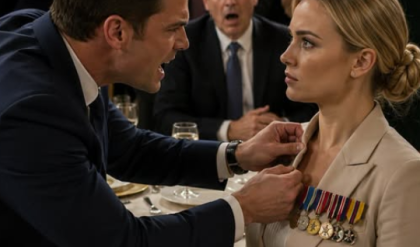
He grabbed her arm.
Not hard enough to bruise in front of cameras.
Just hard enough to remind her of all the private rooms where control had lived between them.
“Enough,” he hissed.
Rita looked down at his hand.
So did every camera.
She lifted the microphone.
“Let go of me.”
He did not.
Two security officers started toward the stage.
Then the ballroom doors opened again.
This time, no one gasped.
They froze.
Federal agents entered in dark suits, moving with quiet precision between tables of stunned donors and wilting orchids.
At their center was a woman with silver hair and a badge clipped to her belt.
Cain released Rita’s arm.
Too late.
The lead agent climbed the stage steps.
“Cain Santana,” she said, “you need to come with us.”
Cain gave a sharp laugh.
“Do you know who I am?”
The agent’s expression did not change.
“Yes.”
That single word broke something.
Not loudly.
But everyone heard it.
Cain looked toward Marcus Williams.
Marcus would not meet his eyes.
Diana had already removed herself from Sophia’s side.
That was how fast society loved you when the cameras turned.
Cain looked at Rita then.
For the first time all night, he looked afraid.
Not remorseful.
Afraid.
“Rita,” he said.
Her name in his mouth sounded suddenly small.
She remembered him at twenty-nine, standing in a half-finished duplex with dust in his hair, telling her, “One day, I’ll build something with your name on it.” She remembered believing him.
She remembered the first scholarship recipient, a girl named Lidia who cried into Rita’s shoulder because no one had ever told her her drawings mattered.
She remembered Cain coming home late, kissing her forehead, saying, “I couldn’t do any of this without you.”
Maybe he had meant it once.
Maybe that was the cruelest part.
Rita stepped back.
The agents took Cain.
No handcuffs at first.
Wealth was allowed dignity even when caught bleeding from its teeth.
But then Cain turned toward Sophia.
“You need to call my lawyer,” he snapped.
“Don’t just stand there.”
Sophia flinched.
Rita saw it.
A small thing.
A true thing.
Beneath the emerald satin and diamond earrings and public arrogance was a young woman suddenly realizing that the future Cain had promised her was not a crown.
It was a cage with better lighting.
Cain tried to descend the steps.
A photographer shifted.
Cain shoved him.
The agents moved.
Metal flashed.
The handcuffs clicked around Cain Santana’s wrists beneath the chandeliers he had paid to shine on him.
The sound was tiny.
It echoed forever.
The ballroom erupted.
Voices.
Chairs scraping.
Phones rising.
Donors whispering.
Reporters pushing forward.
The chairman sweating through his collar.
Marcus Williams making calls that no one answered.
Diana crying without tears.
Rita stepped away from the podium.
Her knees shook now.
Of course they did.
Courage is not the absence of shaking.
Sometimes courage is letting your body tremble after your soul has already done the impossible.
She walked down from the stage alone.
Halfway across the ballroom, Sophia called her name.
“Rita.”
Rita stopped.
The younger woman stood at the foot of the stage, one hand on her belly, mascara gathering beneath her eyes.
“I didn’t know,” Sophia whispered.
Rita looked at her for a long moment.
She wanted to hate her.
A clean hatred would have been easier.
But Sophia looked young suddenly.
Not innocent.
Not blameless.
Just young.
Young enough to mistake being chosen for being safe.
“You knew about me,” Rita said.
Sophia’s lips parted.
No defense came.
Rita’s voice softened, and that somehow hurt more.
“That should have been enough.”
Sophia lowered her head.
The sentence landed between them, quiet and final.
Rita kept walking.
Outside the ballroom, the corridor was cooler.
The casino noise floated up faintly from below: bells, laughter, coins, a thousand people losing things under bright lights and calling it fun.
Rita reached the restroom and locked herself in the last stall.
Only then did she break.
Not beautifully.
Not cinematically.
Her mouth opened and no sound came out at first.
Then it came all at once, raw and torn, her body folding over itself as if grief had hands and was wringing her from the inside.
She cried for the marriage.
For the woman she had been.
For the children she had quietly imagined with Cain before learning he had offered fatherhood elsewhere like a gift wrapped in public cruelty.
She cried for every time she had edited herself smaller so his shadow could look larger.
Then she washed her face with cold water and looked in the mirr