He Toasted His Mistress With My Love Story.
Then I Took the Microphone.
My husband gave a birthday speech for his mistress using the story of how we met.
Not a version of it.
Not a careless echo.
Not a sweet little coincidence that could be forgiven after two glasses of champagne and a private apology in the coatroom.
He stole every sacred detail.
The rain on Madison Avenue.
The tiny coffee shop with fogged windows.
The red umbrella I had bought for twelve dollars from a street vendor because the sky opened like it had been waiting for me all day.
The way he said I laughed when the wind turned it inside out.
The way he told me I looked like “a woman the city had invented for him.”
Only tonight, standing beneath a chandelier that looked like frozen lightning, he said all of it to her.
Sienna Voss sat at the center of the ballroom in a silk champagne gown, glowing under the attention that had once belonged to me.
Her hand rested over her heart as my husband, Grant Ashford, lifted his crystal flute and looked at her the way men look at expensive things they have not paid for.
“To the woman who changed my life,” he said.
The guests sighed.
I stood in the back of the room, half hidden behind an arrangement of white orchids taller than a child, and felt something ancient and quiet inside me finally close its eyes.
For eleven years, I had been Mrs. Grant Ashford.
For eight of those years, I had been invisible.
And for the last six months, I had been preparing.
When the applause rose, soft and glittering, I stepped forward.
My heels clicked against the marble.
One by one, heads turned.
Grant saw me, and the color slipped from his face so completely that for a second, I almost felt sorry for him.
Almost.
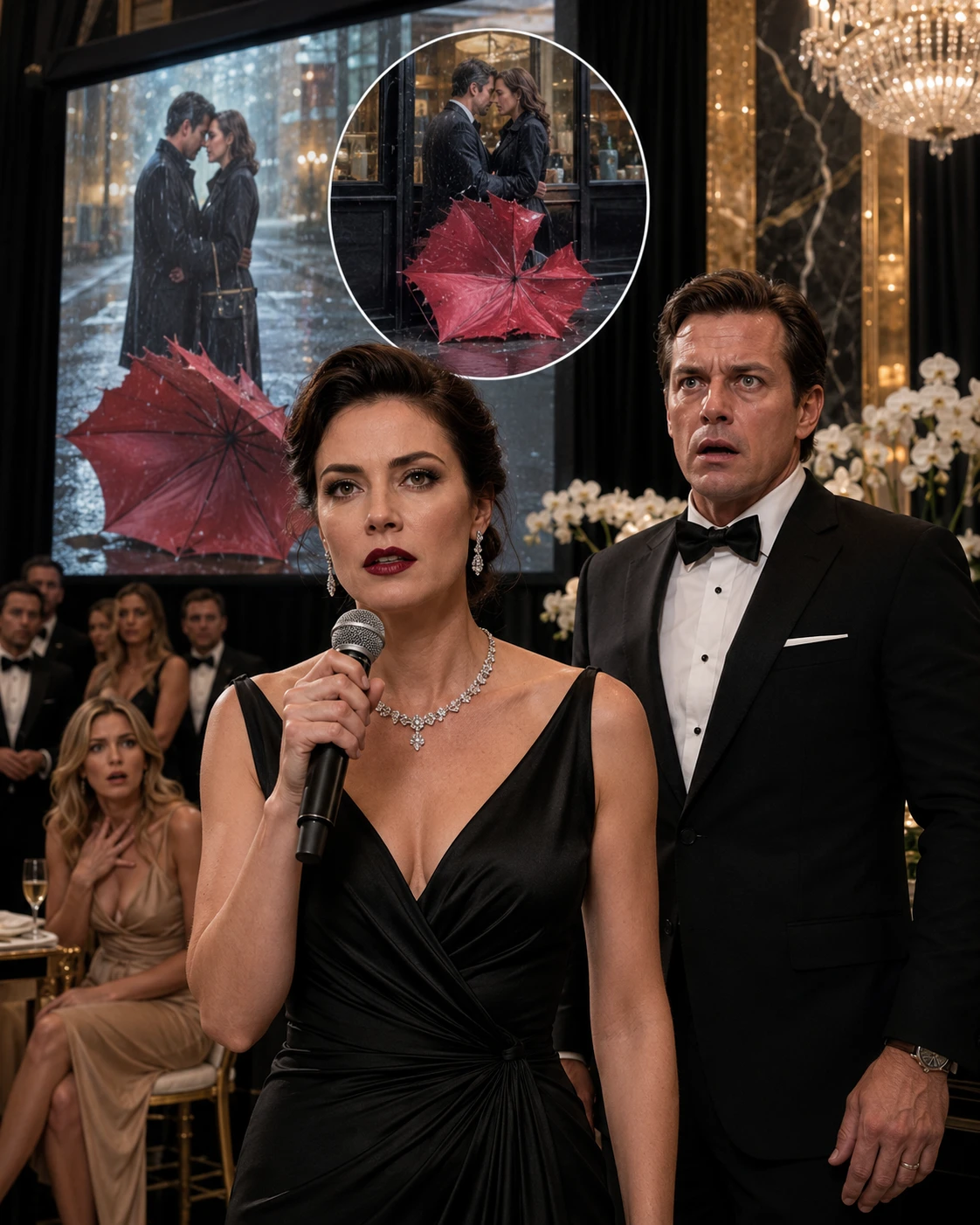
I took the microphone from the stunned event host and smiled at the room.
“Beautiful story,” I said.
“Too bad I was the woman in it.”
CHAPTER 1: The Woman at the Back of the Ballroom
The Avery Ballroom at the Whitmore Hotel in Manhattan was designed for people who liked to pretend wealth was effortless.
Gold-veined marble ran beneath everyone’s feet.
Black velvet draped the walls like mourning cloth for the rich.
The air smelled of gardenias, French perfume, and money old enough to have lost its conscience.
A pianist played near the terrace doors, not loudly enough to interrupt secrets, just softly enough to make them feel expensive.
I knew that room well.
I had chosen the chandeliers.
Grant had forgotten that.
Men like Grant always forgot the origin of beautiful things once they started believing they deserved them.
I arrived twenty minutes late on purpose, wrapped in a black satin gown with a neckline modest enough for a widow and diamonds sharp enough for a threat.
My hair was swept back.
My lipstick was a deep wine red.
Around my left wrist was a bracelet Grant had given me for our fifth anniversary, back when he still remembered to look ashamed after lying.
I did not wear my wedding ring.
Not because I had misplaced it.
Because tonight, I wanted my hand free.
Sienna’s birthday party had been announced as a private celebration for “close friends and select industry leaders,” which was a graceful way of saying half of New York’s wealthiest social climbers had come to watch a twenty-eight-year-old lifestyle influencer unwrap gifts from men with wives.
She was very beautiful, I’ll give her that.
Not beautiful in a dangerous way.
Not the kind of beautiful that unsettled a room.
Hers was carefully packaged beauty: honey-blonde waves, soft pink mouth, skin polished by money and lighting, eyes wide enough to look innocent only when photographed from the right angle.
She had built a following by filming morning routines in silk robes and calling them “soft luxury.” Four million women watched her pour lemon water into crystal glasses and pretend the world was kind to anyone who woke up before sunrise.
Grant adored women other men envied.
He had adored me once, back when I was still useful to his story.
When I met him, I was twenty-six and wearing a navy coat with a broken button.
He was thirty-two, ambitious, charming, and damp from the same storm that had chased me into a little coffee shop called Maribel’s on Madison.
He offered me a napkin when my umbrella collapsed.
I offered him half my table because the café was full.
He told me he was building a luxury development firm from nothing.
I did not tell him my full name.
Not at first.
I told him I was Evelyn Hart.
He told me he was Grant Ashford and said it like a promise.
The truth was, I had been born Evelyn Whitmore-Hart, granddaughter of Eleanor Whitmore, the woman who owned half the boutique hotels from New York to Palm Beach and had taught me before I could drive that a woman should never enter a room without knowing how to leave it.
But I was tired of men who saw my last name before they saw me.
So Grant got Evelyn Hart, the woman with the red umbrella and rain in her hair.
He said he loved her.
For a while, I believed him.
Then I married him.
Then I funded him.
Quietly.
Strategically.
Completely.
When Grant’s company, Ashford Urban Group, nearly collapsed during its second expansion, I moved money through a private investment vehicle my grandmother had built decades before.
When he needed introductions, I made them without putting my fingerprints on the glass.
When banks hesitated, I arranged reassurance.
When he needed a hotel partner for his first landmark renovation, the Whitmore Group signed.
Grant called it fate.
I called it love.
That was my first mistake.
My second was letting him believe love meant silence.
By the time Sienna entered his life, I had already learned the special loneliness of being married to a man who worshiped his reflection in your eyes but resented you for being the mirror.
He met her at a charity gala in Miami, where she had been paid to post three stories and mention the sponsor’s name correctly.
Within two months, she was wearing Cartier bracelets that matched the ones I found on our joint credit card statement under “client gifting.” Within four, she was seated beside him at dinners where I was told the table was full.
By five, her birthday party was being held in my family’s hotel.
And by six, I knew everything.
Not because I followed him.
Not because I screamed.
Not because I checked his phone while he slept beside me like a stranger.
Because Grant made the mistake most arrogant men make.
He underestimated the woman who had made him powerful.
I watched from the back of Sienna’s party as Grant stood to speak.
He tapped his glass with a silver knife, and the room obediently hushed.
Sienna lifted her chin with practiced surprise.
Cameras rose.
Phones glowed.
Someone whispered, “This is going to be so romantic.”
I felt my assistant, Naomi, step beside me.
“Mrs. Ashford,” she murmured, “you don’t have to do this.”
I looked at my husband.
His tuxedo fit perfectly.
His smile looked expensive and empty.
He rested one hand on the back of Sienna’s chair, close enough to claim her without touching her.
“Oh,” I said softly, “I absolutely do.”
Grant began.
“I met her on a rainy afternoon in New York,” he said, voice warm with performance.
“I ducked into a coffee shop to escape the storm, and there she was, fighting with a red umbrella like the city had personally offended her.”
A ripple of laughter moved through the guesTS.
My throat went still.
Naomi inhaled sharply.
Grant smiled at Sienna.
“She let me share her table, even though I was dripping water all over her shoes.
She ordered black coffee.
I ordered tea, because I was trying to seem more interesting than I was.”
More laughter.
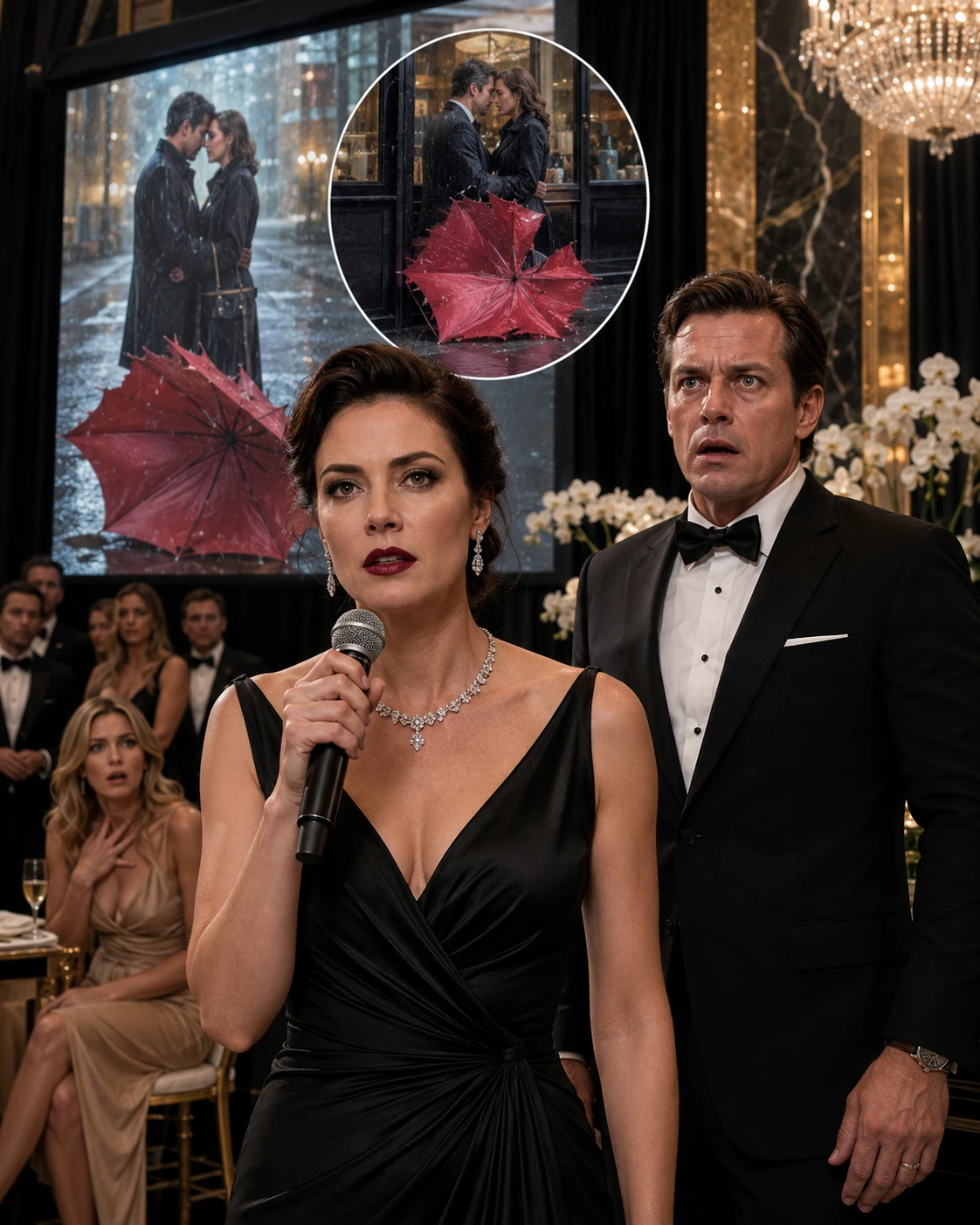
He paused with the timing of a man who had told this story many times.
“And then she looked at me and said, ‘You don’t have to pretend.
The rain already made you honest.’”
My words.
My exact words.
Sienna pressed her fingers to her lips, as if touched by a memory she had never lived.
Grant continued, and each sentence was a small, elegant murder.
He described my umbrella.
My laugh.
My coffee order.
The book I had been reading.
The way we walked six blocks under the same broken umbrella because neither of us wanted the moment to end.
Only in his version, the woman was Sienna.
The guests melted.
The cameras recorded.
The internet waited.
“And ever since that day,” Grant said, lifting his glass, “I have known that some people don’t enter your life.
They rescue it.”
Sienna’s eyes shone.
I almost admired her.
Not for stealing my husband.
Husbands cannot be stolen unless they first decide to wander.
No, I admired the nerve it took to sit there wearing another woman’s memory like borrowed diamonds.
Grant finished with a flourish.
“To Sienna.
My storm, my shelter, my second chance.”
The room erupted.
I waited three seconds.
Long enough for the applause to peak.
Long enough for the phones to stay up.
Then I walked forward.
CHAPTER 2: The Birthday Toast That Broke the Internet
The first thing people noticed was not my face.
It was the silence I carried.
Some women enter a room begging to be seen.
Others enter it with such certainty that the room remembers it was built around them.
I had spent years becoming the second kind.
My heels struck the marble in clean, measured notes.
The pianist stopped playing.
A waiter froze with a tray of champagne.
The event photographer lowered his camera, then lifted it again because instinct is stronger than manners.
Grant stared as if I had risen from a grave he personally purchased.
“Evelyn,” he said, but the microphone caught it, and my name passed through the speakers like a warning.
Sienna turned.
For the first time that night, her expression was not camera-ready.
I held out my hand to the host, a young man in a velvet jacket who looked like he would rather be trapped in an elevator with a tiger than between a wife and a mistress.
“The microphone,” I said.
He gave it to me.
Grant moved quickly, too quickly.
“Evelyn, this is not the time.”
I looked at him.
He stopped.
It is amazing how a man can forget the sound of your voice until he hears the version of it that no longer loves him.
I faced the room.
“Good evening,” I said.
“For those of you who don’t know me, my name is Evelyn Ashford.”
A murmur moved through the crowd.
Someone whispered, “His wife?”
Someone else said, “I thought they were separated.”
We were not.
Grant had simply discovered that if you stop bringing your wife places, people will invent an explanation polite enough not to embarrass themselves.
I smiled.
“First, let me wish Sienna a happy birthday.
Twenty-nine is a beautiful age.
Old enough to know better, young enough to pretend you don’t.”
A few nervous laughs slipped out before people could stop them.
Sienna’s cheeks flushed.
Grant’s jaw hardened.
“Evelyn,” he said quietly, “don’t.”
I ignored him.
“That was a lovely speech, Grant.
The rain.
The coffee shop.
The red umbrella.
The woman who told you the rain had already made you honest.”
I turned to Sienna.
“Did he tell you that line was yours?”
Her lips parted.
The ballroom became so quiet I could hear ice settling in glasses.
Sienna looked at Grant, then back at me.
She tried to laugh, but it came out too thin.
“I don’t know what you think you’re doing.”
“No,” I said gently.
“That has been the problem from the beginning.”
I lifted my phone.
Behind me, the large screen that had been looping soft-focus footage of Sienna’s birthday shoot changed.
Naomi stood at the media table with a calm expression and one finger on the controls.
The screen showed a photograph.
A small coffee shop with fogged windows.
Maribel’s on Madison.
Eleven years earlier.
There I was, younger, rain-soaked, laughing beside a red umbrella turned inside out.
Grant stood beside me, grinning at me with an expression I had not seen on his face in years.
A collective gasp rolled through the room.
Sienna went pale.
Grant looked toward the media table.
“Turn that off.”
Naomi did not move.
I kept my eyes on the guesTS.
“That photo was taken by the owner of Maribel’s, who thought we looked like a romantic comedy she wanted to remember.
She sent it to me the week after Grant proposed.”
The screen changed again.
A scanned page from Grant’s old journal appeared, his handwriting large and slanted.
Rain.
Red umbrella.
Evelyn said the rain made me honest.
I think I met my wife today.
The room shifted.
Not loudly.
Worse.
Quietly.
People began to understand, and rich people hate understanding anything that requires them to take a side in public.
Sienna’s mother, seated near the front, covered her mouth.
A man in a navy suit whispered, “Oh my God.”
Phones were still recording.
Good.
Grant stepped toward me.
“This is private.”
I turned the full force of my smile on him.
“No, Grant.
You made it a speech.”
The guests reacted before they could pretend not to.
A sharp breath here.
A hand to the chest there.
Someone laughed once, not because it was funny, but because cruelty revealed in satin always has a strange theater to it.
Grant lowered his voice.
“You are embarrassing yourself.”
That was when something inside me, something I had kept polished and civilized for years, finally stood up.
I faced him.
“No.
I am correcting the record.”
He blinked.
“For eleven years,” I said, “I protected your pride like it was a family heirloom.
I let you tell people you built your company alone.
I let you accept awards for doors I opened.
I let you stand in front of cameras and thank your ‘team’ while your wife sat at home editing your speeches, cleaning up your risks, and pretending not to notice the lipstick on your collar because the world is kinder to successful men than humiliated women.”
Grant’s face tightened.
I saw anger arrive before guilt.
It always did.
“Evelyn,” he said, “enough.”
“No,” I said.
“Not nearly.”
Sienna stood now, her chair scraping against the marble.
“This is my birthday.”
I looked at her.
For a heartbeat, I saw the girl beneath the silk.
Not innocent.
Not helpless.
But younger than the room she had tried to conquer.
“Yes,” I said.
“And now it’s memorable.”
Her eyes filled, but I did not trust tears from women who filmed themselves crying in designer bathrooms for engagement.
Grant reached for my arm.
I stepped back before he could touch me.
The movement was small, but everyone saw it.
So did the cameras.
“Do not,” I said softly.
He froze.
Maybe it was the microphone.
Maybe it was the witnesses.
Maybe it was the fact that for the first time in years, he did not know what I owned.
I turned back to the room.
“You all came here tonight for a love story,” I said.
“So let me give you the ending.”
CHAPTER 3: The Woman He Thought He Owned
A week before Sienna’s birthday, Grant had come home smelling like her perfume.
White amber.
Peony.
Something sugary beneath it that made the elevator feel smaller.
He found me in the library of our Upper East Side townhouse, reading contracts beneath a green banker’s lamp.
He hated that lamp.
He said it made the room look like an old money law office.
That was precisely why I kept it.
“There’s an event next Friday,” he said, loosening his tie.
“A birthday thing.
Client-related.”
I turned a page.
“For Sienna?”
He paused just long enough.
Then he smiled.
The smile was careful.
Patient.
The smile men use when they believe a woman is being emotional instead of accurate.
“She’s valuable to the campaign.
Her audience overlaps with our buyers.”
“Does her audience know you’re married?”
His expression cooled.
“Don’t start.”
There it was.
The phrase that turns a wife’s pain into poor manners.
I closed the folder in front of me.
“Grant, I’m going to ask you once.
Are you in love with her?”
He laughed.
Not because the question was funny.
Because honesty had become inconvenient.
“I’m not doing this tonight.”
“You’re doing something.”
He looked around the library, at the first editions, the brass clock, the portrait of my grandmother above the fireplace.
Then he looked at me.
“You know what your problem is, Evelyn? You think restraint makes you powerful.
It doesn’t.
It makes you cold.”
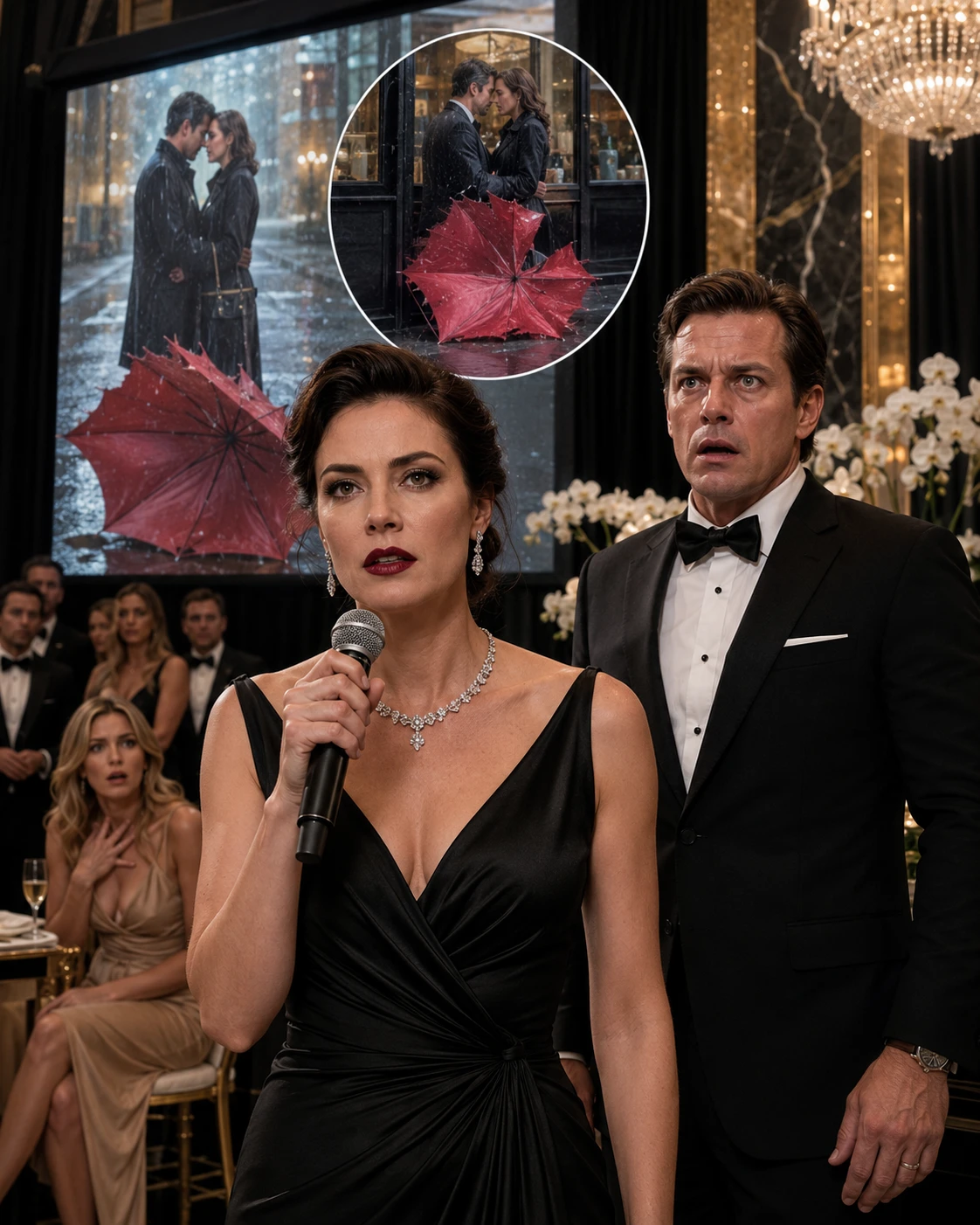
I remember that clearly because I almost smiled.
Men call women cold when they can no longer find the handle.
He stepped closer.
“Sienna makes people feel alive.
She doesn’t sit in dark rooms judging everyone.
She celebrates life.
She understands the image I need.”
“The image,” I repeated.
“Yes,” he snapped.
“The image.
Do you know what it’s like dragging a ghost through every room? Do you know how exhausting it is to be married to someone who never needs anything?”
I did need things.
I needed loyalty.
I needed tenderness.
I needed the man I loved not to hand my memories to a woman who mistook attention for intimacy.
But women like me are trained early not to bleed where predators can smell it.
So I said nothing.
Grant mistook my silence for defeat.
He always did.
He walked to the bar cart, poured himself bourbon, and said, “Don’t come Friday.
You’ll make everyone uncomfortable.”
I looked at the amber light through the glass.
“Of course,” I said.
He exhaled, relieved.
That was his last mistake.
Because while Grant was sleeping upstairs that night, I sat beneath the green lamp and opened the file Naomi had delivered.
Six months of invoices.
Hotel bills.
Jewelry receipTS.
Emails.
Shell payments from Ashford Urban Group marked as “digital partnership expenses.”
A draft press release announcing a new lifestyle development brand with Sienna as “creative muse.”
And one more document.
The one that made me stop breathing.
A proposed divorce settlement.
Not sent.
Not discussed.
Prepared.
Grant planned to offer me the townhouse, a quiet payout, and the “dignity of privacy.” In exchange, I would release all claims to Ashford Urban Group, including any historical capital contributions that were “unofficial, indirect, or undocumented.”
I read that sentence three times.
Unofficial.
Indirect.
Undocumented.
He wasn’t just leaving me.
He was trying to erase me.
The next morning, I called my grandmother’s attorney, a woman named Margaret Bell whose smile had frightened billionaires since 1987.
“Is it time?” Margaret asked.
I looked out at the city, the glass towers burning gold in the morning sun.
“Yes,” I said.
“But I want it clean.”
Margaret gave a small laugh.
“My dear, clean is expensive.”
“I know.”
“How public?”
I thought of Grant telling Sienna my love story in advance, because I knew him well enough to recognize rehearsal when I heard one.
I thought of him warning me not to come.
I thought of all the women who had swallowed humiliation because dignity was mistaken for silence.
“As public as he made it,” I said.
That was how the plan began.
Not with rage.
Rage is messy.
Rage stains carpets and makes headlines easy to dismiss.
No, the plan began with paperwork.
We traced the investment vehicle that had supported Grant’s company from its second year.
We confirmed the clauses he had never bothered to read because he thought anonymous money was stupid money.
We activated the conversion rights tied to three emergency funding rounds.
We verified his misuse of company funds for personal gifts and private travel.
We prepared board notices, legal holds, and a press statement so elegant it could cut glass.
Then Margaret asked me the question she had been waiting to ask for years.
“Does he know the Whitmore Group owns the Avery Ballroom?”
I smiled for the first time in days.
“No,” I said.
“Grant believes the hotel is simply a venue partner.”
Margaret sighed with satisfaction.
“Men really do make their own traps.
We merely provide lighting.”
By Friday afternoon, everything was ready.
Grant believed I would stay home.
Sienna believed she was about to be crowned.
The guests believed they were attending a birthday party.
And I?
I arrived through the private entrance beneath my grandmother’s hotel, where the staff still called me Miss Evelyn when no one important was listening.
In the service elevator, Naomi touched my shoulder.
“Are you sure you want to do it yourself?”
I looked at my reflection in the polished steel doors.
Black gown.
Red mouth.
No ring.
“I loved him myself,” I said.
“I’ll bury the lie myself.”
Now, in the ballroom, with every phone raised and every face fixed on mine, I saw Grant beginning to understand.
Not all of it.
Not yet.
Just enough to be afraid.
I lifted the microphone again.
“Many of you know my husband as the founder of Ashford Urban Group,” I said.
“A self-made man, as he likes to say.”
Grant’s eyes sharpened.
There it was.
Not fear for our marriage.
Fear for his brand.
“The truth is,” I continued, “Ashford Urban Group survived its early years because of a private trust called Red Umbrella Capital.”
The screen behind me shifted.
A simple logo appeared: a red umbrella over clean black lettering.
A murmur moved through the room.
 Woman Tries To Grieve Her Ex-Husband, Then Discovers He Lied To Almost Every Woman In His Life
Several investors leaned forward.
Grant stared at the screen as if it had slapped him.
I smiled.
“Surprise, darling.”
CHAPTER 4: Red Umbrella Capital
People love a romance.
But they will abandon it instantly for a scandal with documenTS.
I watched the room change shape.
The birthday party dissolved.
The ballroom became a courtroom without a judge, a theater without actors, a confession booth with champagne.
Grant’s hand tightened around his glass.
“Evelyn,” he said, low and warning, “you don’t want to do this.”
“Grant,” I said, “you don’t know what I want.”
The screen behind me displayed a timeline.
Year Two: Emergency bridge financing.
Year Three: Private guarantor support.
Year Four: Hospitality partnership introduction.
Year Six: Strategic land acquisition funded through Red Umbrella Capital.
Year Nine: Conversion rights triggered by breach of governance agreement.
I heard a man near the front whisper, “Conversion rights?”
His wife whispered back, “That sounds bad.”
It was.
For Grant.
I turned slightly so the cameras could catch both my face and his.
“Red Umbrella Capital was created eleven years ago.
I named it after the day I met my husband.
It funded his company when no bank would touch him.
It guaranteed his loans.
It introduced him to the partners whose names built his reputation.”
Grant set down his glass too hard.
Champagne spilled over the rim.
“This is absurd,” he said.
“You’re making yourself look vindictive.”
I let the word hang.
Vindictive.
Women are called vindictive when they bring receipts to a conversation men expected to win with charm.
I looked at the crowd.
“Tonight is not about revenge,” I said.
“Revenge is emotional.
This is governance.”
A few people laughed, then quickly stopped when they realized I was not joking.
I continued.
“As of five o’clock this evening, after multiple documented breaches and unauthorized use of corporate funds, Red Umbrella Capital exercised its contractual righTS. It now holds controlling interest in Ashford Urban Group.”
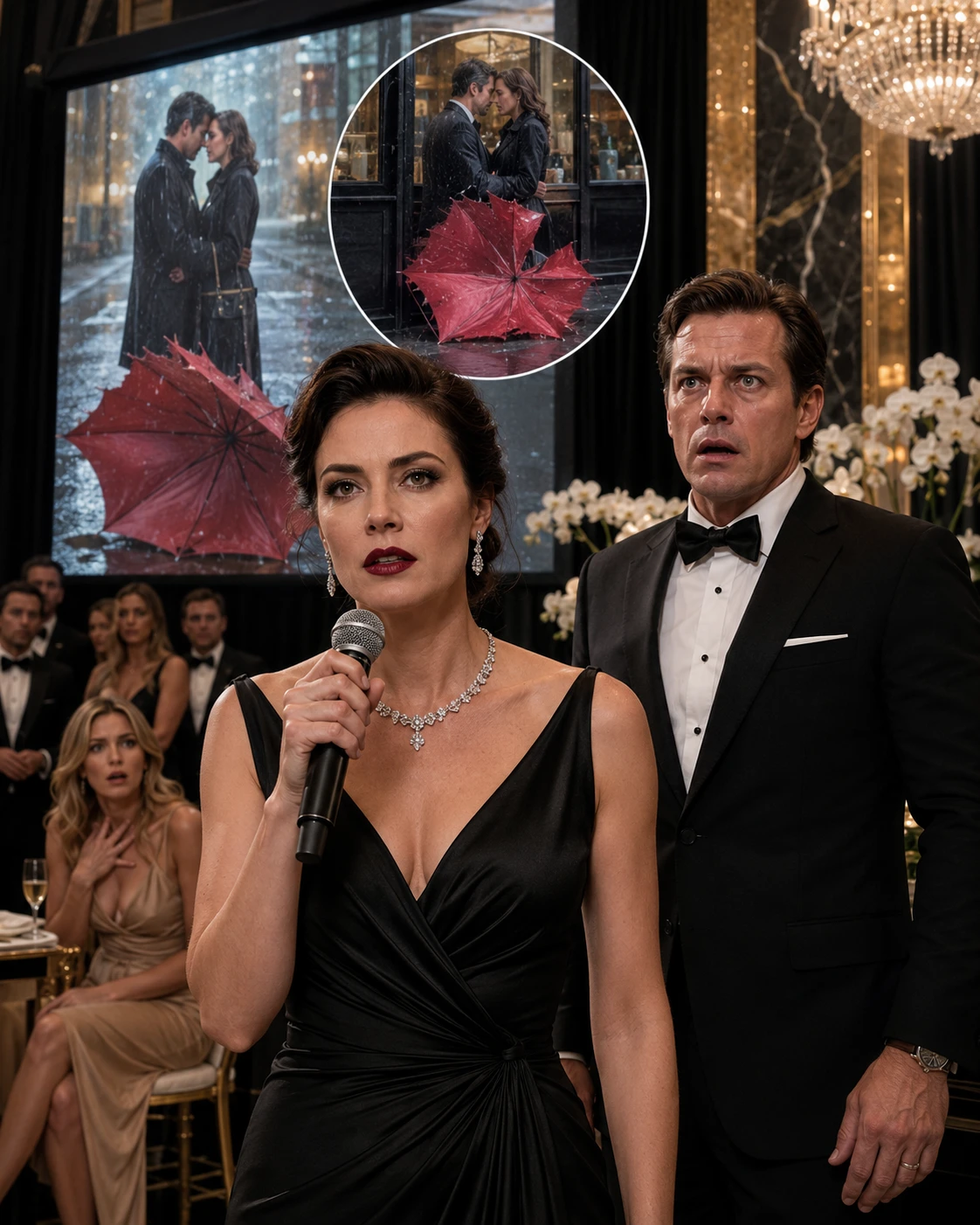
The ballroom exploded into whispers.
Grant’s face changed.
For the first time since I had known him, he looked small in an expensive suit.
“That’s not possible,” he said.
“It is,” I replied.
“You signed the agreemenTS.”
“I didn’t sign anything that gives you—”
“You signed everything,” I said.
“You just never read what came from a woman you thought was too loyal to protect herself.”
The silence after that was not empty.
It was full of knives.
Sienna stepped back from the table, one hand pressed to her stomach.
“Sienna,” I said, turning to her, “you should know something too.”
Her eyes widened.
“Please don’t,” she whispered.
For one second, the room saw the truth.
She knew.
Maybe not all of it.
Maybe not the contracts, not the trusts, not the full machinery of what Grant had tried to do.
But she knew about me.
She knew there was a wife.
She knew the story was stolen.
And still she had smiled for the cameras.
I did not raise my voice.
That would have made it too easy to call me cruel.
“Your lifestyle contract with Ashford Urban Group was paid through corporate accounts under false expense categories,” I said.
“Those payments are now under review.
Any legitimate invoices will be honored.
Any fraudulent ones will be referred to counsel.”
Her mouth trembled.
Someone lowered their phone, then lifted it again.
Grant moved between us.
“Leave her out of this.”
I tilted my head.
“How noble.
Six months late, but noble.”
His nostrils flared.
“You think money makes you untouchable.”
“No,” I said.
“I think truth makes me finished.”
He frowned.
“Finished?”
“With you.”
There it was.
Not shouted.
Not sobbed.
Not begged.
Just spoken.
Grant looked around the ballroom, calculating.
I could see him searching for allies, for men who owed him favors, for women who disliked me enough to doubt me.
But public power is a delicate thing.
It follows confidence first, evidence second, and money always.
Tonight, I had all three.
The hotel’s general manager, Thomas Reed, stepped forward from the side of the room.
He was a silver-haired man with the calm posture of someone who had removed drunk senators from penthouses without wrinkling his jacket.
“Mrs. Ashford,” he said, “would you like me to proceed?”
Grant spun toward him.
“Proceed with what?”
Thomas looked at him without expression.
“Mr. Ashford, as of this evening, the Whitmore Group has terminated Ashford Urban Group’s pending development partnership for cause.
Formal notice has been delivered to your office and board counsel.”
Another wave of whispers.
“The Whitmore Group?” Sienna said faintly.
She looked at me.
For the first time, she really looked.
Not at the wife.
Not at the humiliation.
Not at the obstacle.
At the woman standing in the center of a hotel that bore her grandmother’s name.
I smiled softly.
“My full name is Evelyn Whitmore-Hart Ashford,” I said.
“Though after tomorrow, I expect to use fewer syllables.”
The reveal landed like thunder wrapped in silk.
Phones rose higher.
Someone actually said, “Holy—” before his date elbowed him.
Grant’s face went bloodless.
Because he knew the Whitmore name.
Everyone in that room did.
The Whitmore Group owned hotels, residences, restaurants, and private clubs across the country.
We did not shout.
We did not trend.
We did not need to.
Our signatures moved quietly through boardrooms where louder people waited outside.
Grant had spent eleven years bragging that he married “a woman who hated the spotlight.”
He had never realized I owned the building holding it.
Sienna sank slowly into her chair.
Her champagne gown pooled around her like melted gold.
“I didn’t know,” she said, but her voice was too small to carry conviction.
I looked at her with something almost like pity.
“You knew enough.”
Grant stepped toward me again, desperate now.
“Evelyn, let’s talk privately.”
I laughed once.
It surprised me.
Not because it was loud, but because it was free.
“Privately?” I said.
“You toasted your mistress with our love story in front of two hundred people and a dozen cameras.
Privacy left with the first lie.”
His mask cracked.
“You’re destroying me.”
“No,” I said.
“I’m returning you to yourself.”
That was when my phone buzzed in Naomi’s hand.
She glanced down, then leaned close.
“It’s already online,” she whispered.
Of course it was.
In America, humiliation travels faster than emergency services.
Within minutes, clips had hit Facebook, Instagram, TikTok, and whatever platform people pretended not to use while using it constantly.
The caption wrote itself.
Billionaire hotel heiress exposes husband after he uses their love story in mistress’s birthday speech.
No one knew yet that I was not a billionaire in my own right.
The internet never waits for accuracy before choosing a crown.
But the story had everything it loved.
Luxury.
Betrayal.
A beautiful mistress.
A cold wife who turned out not to be cold at all.
A cheating husband publicly corrected by a woman in diamonds.
Grant understood the speed of it too.
I watched him age ten years in one breath.
CHAPTER 5: The Apology He Never Got to Finish
Security did not drag Grant out.
That would have been vulgar.
Instead, Thomas offered him the kind of professional smile that makes powerful men suddenly remember their manners.
“Mr. Ashford,” he said, “we have a private room prepared for you to make any necessary calls.”
Grant ignored him.
His eyes stayed on me.
For a moment, beneath the fury and humiliation, I saw the man from the coffee shop.
Wet hair.
Cheap tie.
Nervous smile.
A man who had not yet become addicted to applause.
“Evelyn,” he said, softer now.
There it was.
The voice he used when he wanted to return to the beginning.
I hated that it still had a key.
Not to my heart.
No.
To the memory of it.
He took one step closer.
“I made mistakes.”
I looked at him.
The ballroom waited.
That was the thing about public endings.
People expect screaming.
They expect wine thrown, mascara running, a slap that gives everyone permission to gasp.
But my pain had never been theatrical.
It had been private.
Domestic.
Boring in the way slow heartbreak often is.
It had lived in canceled dinners, locked phones, cold pillows, and the subtle humiliation of watching your husband become charming only after leaving the house.
I would not perform my wound for them.
So I gave him the dignity he had denied me.
“You did,” I said.
His face shifted, hopeful.
“But a mistake is forgetting an anniversary.
A mistake is missing a flight.
You built a second life and used pieces of the first one to decorate it.”
He swallowed.
“I was unhappy.”
There it was.
The anthem of selfish men.
I nodded.
“I believe you.”
The room seemed to inhale.
Grant blinked.
“You do?”
“Yes,” I said.
“I believe you were unhappy.
I believe you felt trapped by a life you chased, a wife you resented, and a success you couldn’t admit you did not build alone.”
His eyes shone now, whether from rage or tears I could not tell.
“But your unhappiness did not give you the right to humiliate me.
It did not give you the right to steal from your company.
It did not give you the right to turn our marriage into a branding problem.”
Sienna made a soft sound behind him.
Grant turned slightly, as if remembering she existed.
That was the final cruelty, though no one else noticed.
He had ruined her too, and even now, she was an accessory to him.
I walked to the table where Sienna’s birthday cake stood untouched: five tiers of white fondant, sugar pearls, and gold leaf.
A delicate script across the front read:
To Sienna, the woman who made life beautiful.
I almost smiled.
The pastry chef had excellent penmanship and terrible timing.
I set the microphone on the table beside it.
Then I picked up Grant’s champagne flute.
The room tensed, anticipating drama.
I did not throw it.
I lifted it.
“To the truth,” I said.
A pause.
Then Naomi lifted her glass.
“To the truth.”
Thomas followed.
Then Margaret Bell, who had apparently been seated near the back the entire time in a dark suit and pearls, raised her champagne like a judge accepting a verdict.
One by one, others joined.
Not everyone.
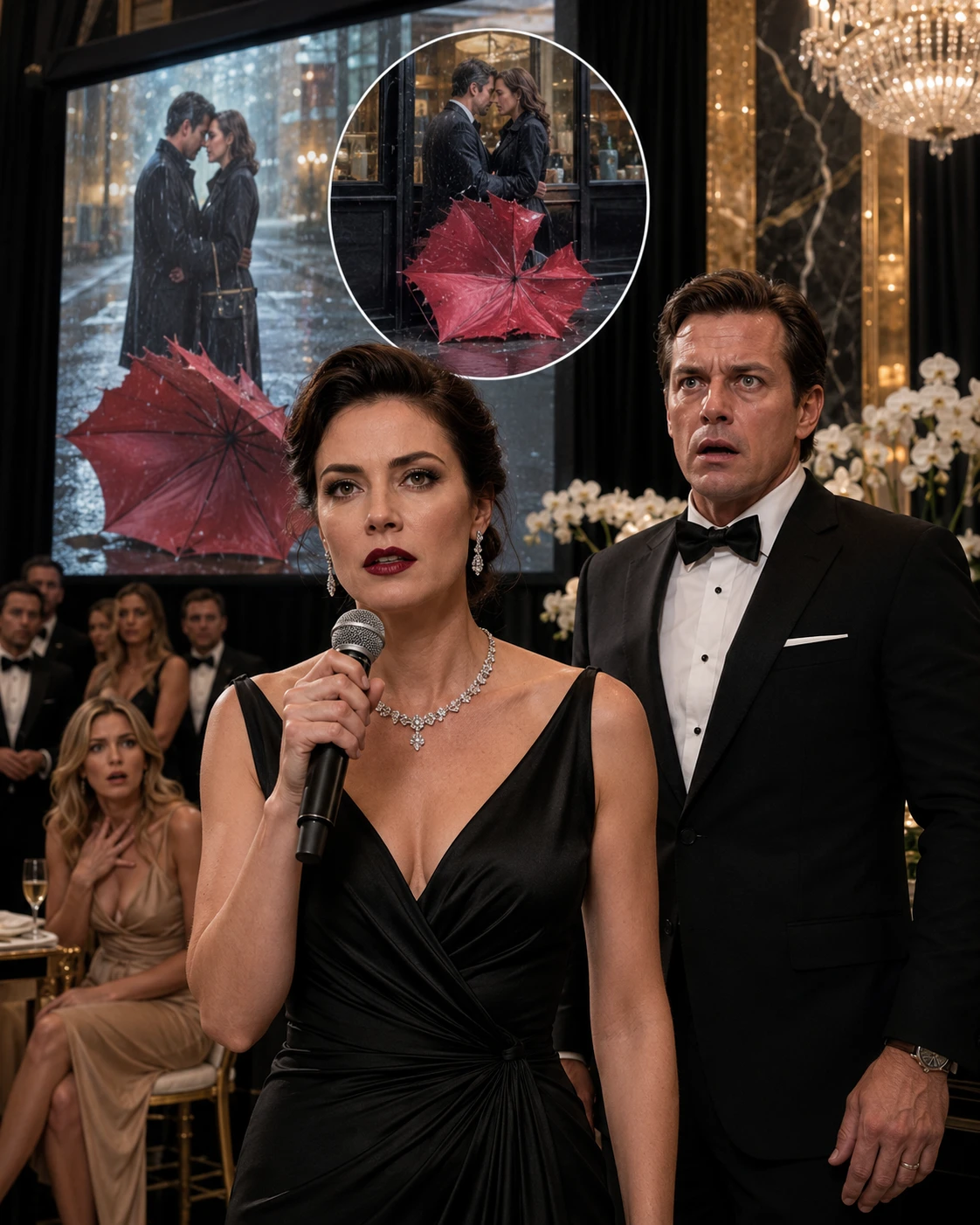
Some were too loyal to Grant.
Some were too frightened.
Some simply disliked women who survived publicly.
But enough.
The sound of glasses rising filled the ballroom.
Grant looked around, betrayed by people who had never been his friends, only his weather.
Sienna stood abruptly.
“I’m leaving.”
Her voice cracked on the last word.
For a moment, I saw the headline version of her dissolve.
No filter.
No soft light.
Just a young woman in a very expensive dress realizing that being chosen by a married man is not the same as being loved.
She gathered her skirt and walked toward the exit.
Halfway there, she stopped and turned back to me.
“I’m sorry,” she said.
It was not enough.
Of course it wasn’t.
But it was the first honest thing she had said all night.
I nodded once.
She left without her cake, her gifts, or the man who had promised her a life built on stolen lines.
Grant watched her go.
Then he looked at me.
“Evelyn, please.”
The word landed heavily.
Please.
How strange to hear it from a man who had mistaken my patience for permission.
“Your things will be moved from the townhouse tomorrow,” I said.
“Margaret will handle all communication.
Do not come home tonight.”
His mouth opened.
Closed.
He looked like he wanted to say he loved me.
I prayed he wouldn’t.
Some lies are unbearable not because they are false, but because some broken part of you still remembers wanting them to be true.
He said it anyway.
“I loved you.”
I looked at him for a long time.
“No,” I said quietly.
“You loved the doors I opened.
You loved the woman who made you feel chosen before you decided being chosen wasn’t enough.”
He flinched.
I took one step closer, lowering my voice so only he and the first row could hear.
“And Grant?”
He stared at me.
“The saddest part is that I would have given you the world if you had only stopped trying to convince everyone you owned it.”
Then I turned away.
That was the moment the clip went truly viral.
Not the documenTS.
Not the reveal.
Not the name Whitmore.
That line.
By midnight, it was everywhere.
Women shared it with captions like:
This is why you never underestimate a quiet wife.
He didn’t cheat on a woman.
He cheated on the foundation.
Red umbrella energy forever.
Men argued in comment sections that I was too cold, too calculated, too public.
Women replied with screenshoTS.
The internet did what it always does: simplified pain into entertainment.
But somewhere inside all that noise, something unexpected happened.
Women began telling their own stories.
Not glamorous ones.
Not ballroom stories.
Not hotel heiress stories.
A nurse from Ohio wrote about a husband who brought his girlfriend to the restaurant where he had proposed to her.
A teacher in Arizona wrote about a fiancé who reused her vows with another woman.
A grandmother in Georgia wrote, “Mine died before he could apologize.
I still wish I had spoken.”
The video became less about me.
That made it easier to breathe.
Three days later, Grant resigned from Ashford Urban Group before the board could remove him.
The company issued a statement so clean it practically sparkled: leadership transition, internal review, continued commitment, no further comment.
Margaret called it “corporate poetry for a public execution.”
Sienna posted one black square, then disappeared for two weeks.
When she returned, she filmed a tearful video about accountability, healing, and learning to value herself outside male validation.
The comments were brutal, then forgiving, then bored.
The internet moved on.
It always does.
But I did not.
Not immediately.
For weeks, I woke before dawn in the townhouse that no longer echoed with Grant’s footsteps.
I made coffee too strong and drank it in the library beneath my grandmother’s portrait.
Sometimes I cried without warning.
Not pretty tears.
Not cinematic tears.
The kind that make your face hurt.
People think revenge cures heartbreak.
It doesn’t.
Revenge is a door closing.
Healing is learning to stop standing outside it.
One morning, Naomi brought me a stack of letters that had arrived at the hotel.
Most were from women.
Some were angry.
Some grateful.
Some simply said, “Thank you for saying it out loud.”
At the bottom of the stack was a small envelope with no return address.
Inside was a photograph.
Maribel’s on Madison.
The coffee shop still existed, though I had not been there in years.
The windows were still fogged.
The awning was still green.
And in the corner of the photo, near the door, was a display of red umbrellas.
A note was tucked behind it.
Mrs. Whitmore,
We saw the video.
Drinks are on us whenever you come back.
Also, we framed the old photo.
Hope that’s okay.
Love,
Maribel
I laughed.
Then I cried again.
Then, for the first time in months, I put on a coat and walked alone through the city.
It rained, because New York has a sense of humor when it wants to.
I did not bring an umbrella.
CONCLUSION: The Morning After the Storm
Three months after the birthday speech, I returned to Maribel’s.
The café was smaller than I remembered, or maybe I had spent too long in rooms designed to make humans feel expensive.
The bell over the door chimed.
Warm air touched my face.
Coffee and cinnamon filled my lungs.
Behind the counter, Maribel herself looked up.
She was older now, with silver in her dark hair and the same kind eyes.
For a second, neither of us spoke.
Then she came around the counter and hugged me like I was not a headline, not a wife, not a woman who had become a symbol without asking.
Just Evelyn.
“I saved the table,” she said.
In the back corner, beneath the framed photograph of Grant and me from eleven years ago, sat the little marble table where it had all begun.
I looked at the picture for a long time.
I expected it to hurt.
It did.
But not the way I feared.
The woman in the photo looked young and open, laughing in a storm beside a man she believed was honest because the rain had made him seem that way.
I wanted to reach into the frame and warn her.
I wanted to tell her to keep the umbrella, keep her name, keep a little more of herself untouched.
But I also wanted to thank her.
She had loved bravely.
There was nothing shameful in that.
I ordered black coffee.
Maribel placed a red umbrella on the chair across from me, folded and dry.
“Just in case,” she said.
I smiled.
Outside, rain blurred Madison Avenue into silver and gold.
People rushed past with collars raised and bags held over their heads.
The city did what it always did: broke hearts, built towers, sold flowers on corners, and kept moving.
My phone buzzed.
A message from Margaret.
The divorce was final.
I read the words once.
Then again.
I waited for the collapse.
It did not come.
Instead, there was a strange quiet inside me.
Not emptiness.
Space.
I placed the phone face down and looked at the red umbrella across from me.
For years, I had thought my love story ended because Grant ruined it.
But he had not ruined the rain.
He had not ruined the coffee shop.
He had not ruined the woman who knew how to laugh when the wind tried to turn her inside out.
He had only removed himself from the ending.
Maribel brought my coffee.
“Anything else, honey?”
I looked out at the storm.
“No,” I said, wrapping my hands around the warm cup.
“I have everything I need.”
And for the first time in a very long time, I believed myself.