PART 3 THE BLACK NOTEBOOK WAS NOT ABOUT TRADITION… IT WAS A MAP OF EVERY LIE IN THAT HOUSE
When I arrived home that evening, the gates of the Salazar house were wide open.
That alone told me something had gone wrong.
Doña Rebeca never left anything open.
Not a drawer.
Not a cabinet.
Not a conversation.
She controlled that mansion like it was a kingdom and everyone inside it had been born to kneel.
The house stood in Lomas de Chapultepec, tall and pale behind iron gates, with old trees pressing shadows over the driveway.
The kind of home people photographed from outside and imagined as a dream.
But dreams do not usually have rules written in black ink about who is allowed to eat.
I stepped from the car carrying my laptop bag, my heels clicking against the stone path.
Inside, someone had broken a glass.
I could hear Doña Rebeca’s voice before I even reached the front door.
“She had no right!”
Then Sebastián’s voice, lower.
“Mother, the bank did not freeze the account because Valeria refused to make eggs.”
I paused with my hand on the doorknob.
Good.
At least he still knew how to speak.
When I entered, the entire family turned toward me.
Doña Rebeca stood in the middle of the living room wearing pearls and fury.
Her brother-in-law, Uncle Arturo, sat on the sofa with a sweating face.
Sebastián’s older cousin, Mariela, stood near the fireplace holding her phone like a weapon.
Two aunts whispered beside the staircase.
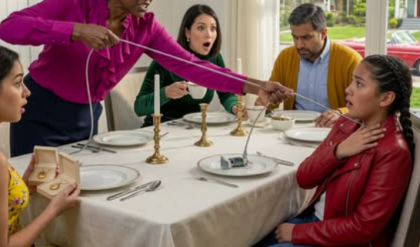
And on the coffee table, between a tray of untouched tea and a silver bowl of almonds, lay the black notebook.
Doña Rebeca saw me look at it and moved fast, snatching it to her chest.
“You searched my room,” she accused.
I blinked once.
“No.
You put it on my bed.”
“That was for house rules.”
“Yes,” I said.
“And apparently also for cash payments, duplicate invoices, supplier initials, and something called the Family Protection Fund.”
The room went silent.
Sebastián stared at his mother.
“What is she talking about?”
Doña Rebeca laughed, but it came out sharp and thin.
“Your wife is dramatic.
One morning in this house and she already wants to destroy us.”
“No,” I said.
“One morning in this house showed me exactly why you needed everyone afraid.”
Her face changed.
Only for half a second.
But I saw it.
I had spent twelve years in finance learning to read faces across negotiation tables.
Men who smiled while hiding bankrupt subsidiaries.
Directors who called a loss “temporary” while moving assets offshore.
Accountants who said “small discrepancy” when they meant prison.
Doña Rebeca’s expression was not anger.
It was alarm.
I walked to the table and placed my laptop bag down.
“This morning, after your ninth call, I asked my assistant to pull public filings connected to Salazar Foods, the household trust, and the foundation registered under your name.”
Uncle Arturo leaned forward.
“You had no authority.”
“I did not access private accounts,” I replied.
“I looked at public documents, vendor registrations, tax liens, court notices, and one open procurement complaint from a supplier who was never paid.”
Mariela frowned.
“What supplier?”
“Luna Produce,” I said.
“A small farm outside Querétaro.
They delivered vegetables for three years to Salazar Foods and were paid late every month.
Then last year, the payments stopped completely.”
“That happens in business,” Arturo muttered.
“Yes.
But their invoices appear in the black notebook as paid in cash.”
Doña Rebeca clutched the notebook tighter.
Sebastián took one step toward her.
“Mother, give it to me.”
She turned on him.
“You will not disrespect me in my own house.”
“Our house,” he said.
She froze.
It was the first time I had heard him say it.
Not her house.
Not the family house.
Our house.
A tiny crack opened in the wall.
Doña Rebeca saw it too.
“That woman has been here one day,” she whispered.
“One day, Sebastián.
And already she has turned you against your blood.”
I looked at my husband.
His jaw tightened, but his eyes dropped.
For a second, I thought the old training would win.
The years of obedience.
The mother who taught him that love meant loyalty, and loyalty meant silence.
Then he lifted his eyes again.
“No,” he said.
“She did not turn me against anyone.
You humiliated my wife on our wedding night.”
Doña Rebeca’s face hardened.
“I taught her respect.”
“You taught me shame,” he said.
The words landed like a chair dragged across marble.
Mariela lowered her phone.
One of the aunts gasped softly.
Doña Rebeca looked at Sebastián as if he had slapped her.
I could see the boy inside him trembling.
The boy who had probably been told to keep quiet, stand straight, kiss his mother’s cheek, never embarrass the family, never question the rules.
But he did not look away this time.
So I spoke before Rebeca could cut him down again.
“Doña Rebeca, I am going to ask you one question.
What is the Family Protection Fund?”
She lifted her chin.
“Money used to protect this family.”
“From what?”
“From people like you.”
I smiled.
Not because it was funny.
Because she had just walked into the cleanest trap in the room.
“Interesting.
Because according to your notes, the fund received cash from suppliers, household budgets, staff deductions, and reimbursements marked for employee meals.”
Aunt Patricia, who had been silent until then, looked up.
“Employee meals?”
I nodded.
“Yes.
Staff meals.
The cooks, drivers, cleaners, gardeners.
The company deducted money every month for their lunches, but according to this notebook, much of that money was redirected.”
“That is impossible,” Mariela said.
“Is it?” I asked.
“Because this morning, at 6:00, Doña Rebeca reminded me that in this family, some people eat after everyone else, if anything is left.”
Nobody spoke.
And that was the first moment they understood.
The notebook was not just about me.
It was about a system.
A quiet, polished, well-perfumed system where the powerful ate first, and everyone else survived on leftovers.
Doña Rebeca stepped toward me.
“You do not know what it took to build this family.”
“No,” I said.
“But I know what it took to hide the losses.”
Her eyes flicked toward Arturo.
There it was.
The second crack.
Sebastián saw it too.
“What losses?” he asked.
Arturo stood.
“This is ridiculous.
We are not discussing company matters with a woman who—”
He stopped himself.
Too late.
I finished for him.
“With a woman who what? Eats last? Works too much? Reads numbers faster than your accountant?”
Mariela covered her mouth, but I could tell she wanted to laugh.
Doña Rebeca pointed at the door.
“Leave my house.”
I did not move.
Sebastián did.
He stepped between us.
“She is my wife.”
“And I am your mother.”
“And I am done being managed like an account you can balance.”
Doña Rebeca recoiled.
The house seemed to inhale.
For years, I think everyone in that family had mistaken silence for peace.
They had mistaken obedience for respect.
They had mistaken Doña Rebeca’s control for wisdom.
But control is not wisdom.
Sometimes control is just fear wearing pearls.
The front doorbell rang.
Everyone jumped.
Mariela looked toward the hall.
“Were you expecting someone?”
I checked my watch.
“Yes.”
Doña Rebeca’s eyes narrowed.
“Who?”
Before I could answer, the housekeeper, Rosa, appeared in the doorway.
She was in her late fifties, small, careful, with hands that looked older than the rest of her.
I had met her only once before the wedding.
She had served coffee while Doña Rebeca introduced her not by name, but as “the woman who has been with us forever.”
Now Rosa looked terrified.
“Señora,” she said softly, “there is a man outside from Luna Produce.
And two others.”
Arturo swore under his breath.
Doña Rebeca turned white.
Sebastián looked at me.
“You called them?”
“I invited them,” I said.
Doña Rebeca almost screamed.
“To my home?”
“To the place where their unpaid food was eaten.”
Rosa’s eyes snapped to mine.
For a moment, something passed between us.
Recognition.
Not friendship yet.
Not trust.
But recognition.
A woman knows when another woman has been told to wait.
“Let them in,” Sebastián said.
His mother spun toward him.
“No.”
He repeated, louder, “Let them in.”
Rosa looked at Doña Rebeca first, out of old habit.
Then she looked at Sebastián.
Then at me.
And finally, for the first time since I entered that house, she made her own decision.
She walked back to the door.
A minute later, three people stepped into the living room.
The first was a man around sixty with sun-dark skin and a hat twisted in his hands.
Beside him stood a woman with tired eyes and a folder pressed against her chest.
Behind them was a younger man, maybe twenty-five, wearing a clean shirt that looked ironed for courage.
The older man nodded politely.
“Good evening.
I am Mateo Luna.”
His voice was steady, but his fingers were not.
Doña Rebeca recovered herself quickly.
“You have no right to come here.”
Mateo looked at her.
“With respect, señora, I have come to many places.
Your office.
Your accountant.
Your reception desk.
Your security gate.
No one opened.”
The woman beside him held up the folder.
“My mother sold her earrings to pay our workers after your company stopped paying us.”
Arturo cut in.
“This is a contractual dispute.
It has nothing to do with—”
“It has everything to do with dinner,” I said.
They all turned to me.
I walked to the coffee table and opened my laptop.
“I am going to show something.
Sebastián, this is your choice.
If you do not want this discussed in the house, we can stop.”
Doña Rebeca looked relieved for half a second.
Sebastián did not.
He nodded.
“Show it.”
I connected my laptop to the television.
The screen lit up with a simple spreadsheet.
No drama.
No music.
No shouting.
Just numbers.
That is the thing about numbers.
When they are clean, they are boring.
When they are dirty, they scream.
I pointed to the first column.
“These are invoices submitted by Luna Produce over the last eighteen monThS. Total unpaid balance: 1.8 million pesos.”
The younger man closed his eyes.
The woman beside him swallowed hard.
I moved to the next column.
“These are ledger entries from documents filed by Salazar Foods.
They show the invoices as paid.”
Sebastián whispered, “Paid to whom?”
I clicked.
A third column appeared.
“Cash withdrawals signed by Arturo Salazar or approved under household authorization.”
Arturo’s face lost color.
“That does not prove—”
“I am not finished.”
I clicked again.
A photo appeared.
One page from the black notebook.
The room stopped breathing.
I had taken it the previous night.
Not because I planned revenge.
Because as soon as I saw figures mixed into “house rules,” instinct told me to document.
The handwriting was unmistakable.
Doña Rebeca’s elegant slanted script.
LUNA — paid in cash — A.S.
confirmed — move difference to F.P.F.
Family Protection Fund.
Sebastián turned slowly toward his uncle.
“A.S.?”
Arturo opened his mouth.
No sound came out.
Doña Rebeca slammed the notebook shut.
“You photographed my private property?”
“You placed financial records on my bed,” I said.
“Beside a rule telling me I could eat leftovers.
Forgive me for assuming you wanted me to study it.”
Mariela let out one shocked laugh.
Doña Rebeca glared at her.
She stopped immediately.
Mateo Luna looked at the screen, then at Sebastián.
“My workers went three weeks without full pay,” he said.
“One of them brought his little girl to the fields because he could not afford childcare.
We kept delivering because your family name meant something.”
The words hit Sebastián harder than any accusation.
He walked toward Mateo.
“I did not know.”
Mateo nodded once.
“I believe you.”
Then he looked at Rebeca.
“But someone knew.”
Doña Rebeca did not blink.
“Business requires hard decisions.”
The woman with the folder stepped forward.
“My father’s blood pressure went through the roof because of your hard decisions.”
“Enough,” Arturo said.
“No,” she replied, her voice shaking.
“Not enough.
We called every week.
Your office said payment was delayed because of audiTS. Your receptionist said the family was traveling.
Your lawyer said we should be grateful your company ever worked with farms like ours.”
Doña Rebeca lifted her chin.
“You are emotional.”
The woman laughed bitterly.
“Yes.
Hungry people often are.”
There it was.
The sentence that cut through every expensive curtain in that room.
Hungry people often are.
The black notebook sat against Doña Rebeca’s chest like a shield, but suddenly it looked small.
Old.
Ugly.
Sebastián turned to me.
“What do we do?”
Doña Rebeca snapped, “We do nothing until I speak to our attorney.”
“No,” Sebastián said.
“You do nothing.
I will speak.”
He faced Mateo Luna and his family.
“By tomorrow noon, your full balance will be paid from my personal account.
Not the company.
Mine.
After that, I will begin a full audit of Salazar Foods and the family trust.
If we owe more, we will pay more.”
Arturo exploded.
“You cannot promise that!”
Sebastián looked at him.
“I can.
I am the majority shareholder.”
The room froze again.
Doña Rebeca stared.
“What did you say?”
Sebastián’s voice shook now, but he kept going.
“Father transferred the majority shares to me before he died.
You told me it was symbolic.
You told me you would manage things until I was ready.”
“You were not ready.”
“I am thirty-seven years old.”
“You are my son.”
“That is not a job title.”
I looked at him then, really looked at him.
This was the man I had married.
Not the silent boy at the breakfast table.
Not the groom who looked down when his mother opened the black notebook.
This man.
Frightened, yes.
Hurt, yes.
But awake.
Doña Rebeca saw the same thing and hated me for it.
“You think she loves you?” she whispered.
“She saw your weakness in one night.”
“No,” I said before Sebastián could answer.
“I saw your damage.”
Her eyes snapped to me.
“And I married him anyway.”
That silenced her.
Not because she agreed.
Because she had no weapon for love that was not blind.
I walked closer to Sebastián and stood beside him.
“I do not need a perfect husband,” I said.
“I need an honest one.
And today he is choosing honesty.”
Sebastián looked at me with eyes bright enough to break my heart.
Then Rosa, who had been standing near the doorway, spoke.
“Señor Sebastián?”
Everyone turned.
The housekeeper clasped her hands together.
“There are more notebooks.”
Doña Rebeca’s face went gray.
“Rosa,” she said softly.
Not loudly.
Softly.
That made it worse.
Rosa trembled, but she continued.
“In the pantry cabinet.
Behind the wedding china.
I have seen them for years.”
“Rosa,” Doña Rebeca repeated.
“Think carefully.”
“I have,” Rosa said.
Her voice cracked, but she did not stop.
“My daughter worked here three summers ago.
You deducted money from her pay for meals, uniforms, and broken dishes she never broke.
When she complained, you told her girls from families like ours should be thankful to stand inside houses like this.”
Mariela whispered, “What?”
Rosa looked down.
“She left crying.
I stayed because I needed the job.”
For the first time all evening, Doña Rebeca looked cornered.
Not by me.
By the woman she had never bothered to see.
Sebastián turned toward the pantry.
“Rosa, show me.”
“No one moves,” Doña Rebeca said.
Nobody listened.
That was the most powerful moment of the night.
Not the spreadsheet.
Not the unpaid invoices.
Not even Sebastián standing up to his mother.
It was the fact that Doña Rebeca gave an order, and the room did not obey.
Rosa led us through the dining room into a large kitchen with copper pans, imported tiles, and a long wooden table.
The smell of burned eggs still lingered from the morning.
On the counter sat a plate of toast, half-eaten.
I wondered if Sebastián had eaten it standing up.
Rosa opened the pantry.
Behind stacks of wedding china wrapped in paper, there was a narrow cabinet.
Inside were six black notebooks.
All identical.
Doña Rebeca made a sound behind us.
Not anger.
Grief.
But not the kind of grief that comes from regret.
The kind that comes from losing control.
Sebastián reached for the first notebook.
His hand shook.
I touched his wrist.
“You do not have to read all of it tonight.”
“Yes,” he said.
“I do.”
He opened it.
The first pages were household rules from years before.
Rules for drivers.
Rules for cooks.
Rules for daughters-in-law.
Rules for holiday seating.
Rules for gift-giving.
Rules for apologies.
Then the pages changed.
Names.
Dates.
AmounTS.
Staff deductions.
Supplier paymenTS.
Donations received by the family foundation.
Cash movemenTS.
Arturo’s initials appeared often.
So did others.
But Doña Rebeca’s handwriting connected everything.
Mariela picked up another notebook and flipped through.
Her face crumpled.
“My scholarship,” she whispered.
Everyone turned.
“What?” Sebastián asked.
She looked at Rebeca.
“You told me the foundation paid for my university semester in Boston because you believed in me.”
Doña Rebeca closed her eyes.
Mariela lifted the notebook.
“This says the money came from donations raised for employee children.”
Aunt Patricia began crying quietly.
The young man from Luna Produce looked at the floor, jaw clenched.
Doña Rebeca straightened, gathering whatever remained of her throne.
“I did what I had to do to keep this family respected.”
“Respected by whom?” Mariela demanded.
“People who came to our parties? People who ate food we did not pay for?”
“You enjoyed the benefiTS.”
“I was twenty,” Mariela said, tears falling.
“You lied to me.”
Doña Rebeca turned to Sebastián.
“And you? You lived in this house.
You drove the cars.
You wore the suiTS. Do not stand there pretending purity because your new wife has embarrassed you.”
Sebastián flinched.
That one hit.
Because it was partly true.
He had benefited.
So had others.
So had I, for one wedding night, standing under chandeliers paid for by a family I had not fully understood.
But guilt can become a door or a prison.
Sebastián looked at Mateo Luna.
“You are right,” he said quietly.
“I did not know.
But I should have asked.”
Mateo did not answer immediately.
Then he nodded.
“That is a beginning.”
Doña Rebeca laughed.
“A beginning? You think farmers and maids will forgive you because you look sad in your expensive kitchen?”
I stepped forward.
“No.
Forgiveness is not the first step.
Payment is.”
She looked at me with hatred sharp enough to cut glass.
“You planned this.”
“No,” I said.
“You did.”
I pointed at the notebooks.
“You documented every humiliation, every deduction, every lie.
You turned cruelty into administration.
I only read what you were proud enough to write down.”
For the first time, she had no answer.
A phone rang.
Arturo looked at his screen and declined the call.
It rang again.
Then Mariela’s phone rang.
Then Sebastián’s.
Aunt Patricia covered her mouth.
“What is happening?”
Sebastián answered his.
“Yes?”
His face changed as he listened.
“Now?”
He looked at me.
“It is the bank.
They received notice of irregular movement in three accounts connected to the foundation.
They want a meeting tomorrow morning.”
Doña Rebeca whispered, “No.”
Arturo stepped back.
“They cannot prove anything.”
I watched him carefully.
People reveal themselves in verbs.
Not “We can explain.”
Not “There is a mistake.”
They cannot prove anything.
Sebastián heard it too.
His face turned cold.
“Uncle Arturo, leave.”
Arturo stared.
“You are making a mistake.”
“I have made enough.”
“You think your wife will save you? She will drag this family into scandal and walk away clean.”
I almost smiled.
Men like Arturo always thought women wanted escape.
He did not understand that some women built rooms instead of running from them.
“I am not walking away,” I said.
Doña Rebeca’s eyes flicked to me.
“Then what do you want?”
I looked at the notebooks.
Then at Rosa.
Then at Mateo Luna and his family.
Then at Sebastián.
“I want every unpaid worker and supplier identified.
Every peso returned.
Every false deduction corrected.
Every foundation donor notified.
Every person in this house who benefited from stolen money given the chance to repay it voluntarily before the law forces them.”
The room was silent.
“And,” I added, turning to Doña Rebeca, “I want the dining room rule changed tonight.”
She blinked.
“You are worried about dinner?”
“Yes,” I said.
“Because that is where your kingdom started.”
I walked back through the kitchen into the dining room.
The long table was set for family dinner.
Crystal glasses.
White plates.
Silver cutlery.
Chairs arranged by invisible rank.
At the head sat Doña Rebeca’s chair.
Everyone followed me.
I stood behind that chair and touched the carved wood.
“How many women ate standing in this kitchen while men discussed business over soup?” I asked.
“How many workers packed leftovers they were told to be grateful for? How many daughters learned silence here? How many wives smiled here while swallowing humiliation?”
No one answered.
I pulled the chair back.
The sound scraped through the room.
Then I looked at Rosa.
“Please sit.”
Rosa’s eyes widened.
“No, señora.”
“Valeria,” I said softly.
“And yes.
Please.”
Doña Rebeca’s voice shook.
“She is staff.”
“She is a woman who kept this house running while you wrote rules about who deserved food.”
Rosa looked at Sebastián.
He nodded.
“Sit, Rosa.”
Slowly, as if the chair might punish her, Rosa sat at the head of the table.
The whole house changed.
I cannot explain it any other way.
The chandelier looked different.
The plates looked different.
The air looked different.
Doña Rebeca stared as if she were watching someone tear down a family portrait.
Maybe we were.
Then Sebastián did something I did not expect.
He walked to the kitchen, picked up the half-eaten plate of toast from the counter, and brought it to the dining room.
He placed it before Rosa.
“I am sorry,” he said.
Rosa began to cry.
Not loudly.
Just one hand over her mouth, shoulders trembling.
Mateo Luna removed his hat.
The young man beside him looked away, blinking fast.
Mariela pulled out the chair beside Rosa and sat.
Then Aunt Patricia sat.
Then the Luna family.
Then Sebastián.
Finally, I sat too.
Only Doña Rebeca remained standing.
At the other end of the table.
Alone.
She looked at the empty chair beside Sebastián, the chair that would have been mine under her old rules only after everyone else finished.
“You think this is justice?” she asked.
“No,” I said.
“This is dinner.”
The simplest word in the world.
And somehow it broke her more than any accusation.
She turned and walked out.
Arturo followed her.
Nobody stopped them.
For a few minutes, no one moved.
Then Rosa wiped her face and said, almost apologetically, “The soup is still warm.”
Mariela laughed through tears.
That was how the first real dinner in the Salazar house began.
Not with a blessing.
Not with a toast.
With soup served by the people who were hungry enough to tell the truth.
Later that night, after Mateo Luna and his family left with Sebastián’s written commitment and my promise to personally review the repayment plan, the mansion became quiet.
Too quiet.
The kind of quiet that follows an earthquake, when people are still alive but no one trusts the walls.
 Wife Threatens Divorce After Husband Ignores Daughter Over Misophonia And College Prep
Sebastián and I went upstairs to the bedroom that had been ours for less than twenty-four hours.
My wedding dress still hung over the chair.
The bed was perfectly made.
But the black notebook was gone.
For one second, my stomach tightened.
Then Sebastián opened the closet.
Inside, on the floor, sat a cardboard box.
Six black notebooks.
Rosa had brought them up while we were saying goodbye downstairs.
Sebastián sat on the edge of the bed and put his head in his hands.
“I am sorry,” he whispered.
I stood in front of him.
“For what?”
“For not stopping her last night.
For looking down.
For letting you handle what I should have handled.”
I took off my earrings slowly.
“You were afraid.”
“That is not an excuse.”
“No,” I said.
“But it is a truth.”
He looked up at me.
“She trained me to think disrespect was disagreement.
If I challenged her, I was ungrateful.
If I asked questions, I was betraying the family.
When my father got sick, she took over everything.
After he died, she told me grief made me weak, and she would protect us until I became stronger.”
His eyes filled.
“I never became stronger.
I just became quieter.”
My anger softened.
Not disappeared.
Softened.
Because sometimes love is not pretending the wound is not there.
Sometimes love is pointing at it and saying, We clean this now.
“Then become louder,” I said.
He laughed once, broken and small.
“I do not know how.”
“You started today.”
He reached for my hand.
“I do not want to lose you.”
“You will not lose me because you were wounded,” I said.
“You will lose me if you use that wound as an excuse to wound me.”
He nodded.
“I understand.”
“Do you?”
“Yes.”
“Then tomorrow morning, we go to the bank.
After that, you call an external auditor.
Not a family friend.
Not your mother’s lawyer.
A real firm.
Then you put Rosa and every household employee on written contracts with fair pay and no illegal deductions.
Then you meet every supplier face-to-face.”
He stared at me.
“You already made a list.”
“I am a financial director, Sebastián.
Of course I made a list.”
For the first time that day, he smiled.
A real one.
Tired.
Sad.
But real.
Then his phone buzzed.
He looked at the screen.
His smile vanished.
“What is it?” I asked.
He turned the phone toward me.
A message from Doña Rebeca.
You think she saved you.
She just opened the grave your father begged me to keep closed.
Below it was a photo.
Old.
Slightly blurred.
A hospital room.
A man in bed.
Sebastián’s father.
Beside him stood Doña Rebeca, younger but unmistakable.
And on the bedside table, next to a glass of water, was a black notebook.
Sebastián stopped breathing.
I took the phone from his hand and zoomed in.
On the open page, only one line was readable.
If Sebastián learns the truth, everything ends.
The room tilted.
“What truth?” he whispered.
Before I could answer, another message arrived.
Ask your wife why her company appears in the oldest notebook.
My blood went cold.
Sebastián looked at me.
“Valeria?”
I could not speak.
Because Salazar Foods had been one of my company’s suppliers years before I became director.
Before I met Sebastián.
Before the wedding.
Before the black notebook landed on my bed.
I reached for the oldest notebook in the box with fingers that suddenly did not feel like mine.
The cover cracked when I opened it.
The pages smelled of dust, ink, and something buried too long.
I turned past old rules, old payments, old names.
Then I saw it.
MENDOZA — settlement closed — daughter must never know.
My maiden name.
My father’s name.
And beneath it, written in Doña Rebeca’s perfect handwriting, was an amount large enough to explain the year my father lost his business, our apartment, and almost his life.
Sebastián stood slowly.
“What does that mean?”
I looked at the page until the letters blurred.
Then I understood the ugliest part of all.
Doña Rebeca had not humiliated a stranger on her wedding night.
She had invited the daughter of one of her victims into her house.
And she had no idea I was about to remember everything.
The next morning, I did not wake at six to make breakfast.
I woke at five.
Not because Doña Rebeca had won.
Because now the war had a name.
My father.
His small distribution company had collapsed when I was sixteen.
I remembered my mother crying at the kitchen table with unpaid bills spread before her.
I remembered my father selling his delivery truck.
I remembered the way he stopped singing in the shower.
I remembered the night he said, “Sometimes powerful people do not steal with masks, mi niña.
Sometimes they steal with contracTS.”
I had not understood.
Now I did.
The Mendoza settlement was not a note.
It was the missing chapter of my childhood.
By seven, Sebastián and I were in my car driving to my parents’ apartment in Coyoacán.
He sat beside me silent, hands clasped, the oldest notebook on his lap like a confession he had not written but still had to carry.
My mother opened the door in her robe.
“Valeria?” she said, alarmed.
“What happened?”
My father appeared behind her, thinner than I remembered from childhood but still tall, still gentle, still the man who kissed my forehead before every exam and told me numbers could protect honest people if I learned to read them well.
Then he saw the notebook.
His face changed.
Not surprise.
Recognition.
“Mamá,” I whispered.
“Papá.
We need to talk about Salazar Foods.”
My mother grabbed the doorframe.
My father closed his eyes.
“Oh, my girl,” he said.
That hurt more than any answer.
We sat at their small dining table, the one where I had learned multiplication, cried over college applications, and celebrated my first salary with supermarket cake.
My father touched the notebook but did not open it.
“Where did you get this?”
“Doña Rebeca put one like it on my bed last night,” I said.
“Then we found the others.”
My mother crossed herself.
Sebastián leaned forward.
“Señor Mendoza, I am sorry.”
My father looked at him.
“Did you do this?”
“No.”
“Did you know?”
“No.”
“Then your apology is not enough yet.
But it is a place to stand.”
Sebastián nodded, accepting the blow.
My father finally opened the notebook.
He turned to the page with his name.
For a long time, he only stared.
Then he spoke.
“I had a contract to supply packaging to Salazar Foods.
Small order first, then bigger.
It was the largest opportunity I had ever had.
I borrowed money to expand.
Bought equipment.
Hired twelve people.”
His voice stayed calm, but my mother was crying.
“They delayed payment,” he continued.
“Then claimed my materials were defective.
They refused the final shipment, but kept part of it.
Their lawyer said if I fought, they would bury me in court cosTS. Then they offered a settlement.”
“The amount written here?” I asked.
He nodded.
“But we never received that.”
Sebastián’s face went pale.
My father looked at him.
“Exactly.”
My mother wiped her eyes.
“We received one-third.
Enough to pay some debt, not enough to survive.
Your father thought the rest went to legal fees.”
I looked at the page again.
MENDOZA — settlement closed — daughter must never know.
“Why daughter?” I whispered.
My father looked at me with such tenderness I almost broke.
“Because you were the one who wrote the letter.”
I froze.
“What letter?”
“You were sixteen,” my mother said softly.
“You found me crying.
You wrote a letter to Salazar Foods asking them to pay your father.
You said he was honest.
You said twelve families depended on them.
You said one day you would become good enough with numbers to prove people like them wrong.”
I did not remember writing it.
Or maybe I had buried the memory because nothing came of it.
My father turned the page.
There, folded between two sheets, was a piece of lined notebook paper.
My handwriting.
You do not know me, but my father says business depends on trust.
Please do not punish honest people because they are smaller than you.
I covered my mouth.
Sebastián stood and walked to the window.
His shoulders shook once.
My father watched him.
“Your mother kept this?”
Sebastián turned back.
“She kept everything.”
“No,” my father said.
“She kept trophies.”
That was the word.
Trophies.
Not records.
Not memories.
Proof of power.
We spent two hours at that table.
My father told us names I wrote down.
Former employees.
Suppliers.
A lawyer who vanished after the settlement.
A bank officer who warned him to stop pushing.
Every detail was a thread.
By noon, I had enough to pull.
Sebastián called the external audit firm from my parents’ kitchen.
Not his mother’s office.
Not the family conference room.
My parents’ kitchen.
That mattered.
He put the call on speaker.
“I want a forensic audit of Salazar Foods, the family foundation, household accounts, supplier payments, and any settlement connected to Mendoza Packaging,” he said.
“No internal staff.
No family lawyers.
Direct reporting to me and my wife.”
The partner on the line paused.
“Mr. Salazar, an audit of that scope may expose significant liability.”
Sebastián looked at me.
“Good.”
By three that afternoon, the first formal notices were sent.
By four, Arturo had stopped answering calls.
By five, Doña Rebeca appeared at my parents’ apartment.
She did not come alone.
She arrived in a black car with a lawyer, a driver, and the same pearls from the night before.
She looked around the modest building lobby as if poverty could stain her shoes.
My mother saw her through the peephole and whispered, “No.”
My father stood.
I touched his arm.
“I will open it.”
Sebastián stood beside me.
When I opened the door, Doña Rebeca looked at me with a smile that would have fooled people who did not know poison could be polished.
“Valeria,” she said.
“We should speak privately.”
“No,” I replied.
“We should speak with witnesses.”
Her eyes flicked to my parents behind me.
Then to Sebastián.
“You brought my son here to turn him against me using an old misunderstanding?”
Sebastián’s voice was quiet.
“You came here because you are afraid.”
She slapped him.
The sound cracked through the hallway.
My mother gasped.
The lawyer looked at the floor.
Sebastián did not move.
A red mark bloomed on his cheek.
For one terrifying second, I saw the little boy again.
Then he lifted his face.
“Do not touch me again.”
Doña Rebeca’s hand trembled.
“You are my son.”
“I am not your property.”
Her eyes filled, but even her tears looked strategic.
“I protected you from your father’s weakness.”
“My father is dead,” Sebastián said.
“Stop using him as a locked door.”
She leaned close.
“You want the truth about your father? Fine.
He knew about the paymenTS. He signed the first settlement.
He begged me to handle it when the company started drowning.
He was not a saint.”
Sebastián flinched.
I felt him almost fold.
So I stepped in.
“Maybe he was not a saint.
That does not make you innocent.”
Doña Rebeca turned on me.
“You know nothing about carrying a family name.”
“I know what it cost my family when yours needed polishing.”
Her lawyer cleared his throat.
“Mrs. Mendoza—”
“Salazar,” Sebastián said.
The lawyer blinked.
“Excuse me?”
“Her name is Valeria Mendoza Salazar if she chooses to use it.
And you will address her respectfully.”
Doña Rebeca stared at him.
This time, I smiled for real.
Not victory.
Pride.
The lawyer adjusted his tie.
“We are prepared to offer a private reconciliation payment to the Mendoza family in exchange for confidentiality and the return of all notebooks.”
My father laughed once.
Not happily.
Disbelievingly.
“You stole from me, crushed my business, kept my daughter’s letter for twenty years, humiliated her on her wedding night, and now you want to buy silence at my dining table?”
Doña Rebeca’s face tightened.
“Everyone has a price.”
My mother stepped forward.
“No.
Some people have a limit.”
That was the moment Doña Rebeca lost the room completely.
Not because of money.
Because she had underestimated the quietest person there.
My mother, who had stretched groceries, sold jewelry, and comforted a husband broken by powerful people, looked at Rebeca with a calm that made even me stand straighter.
“You taught your house that women eat last,” my mother said.
“In my house, women learned to survive while men with expensive pens stole food from our table.
Do not confuse patience with weakness.”
Doña Rebeca’s lawyer looked like he wanted to disappear.
Sebastián opened the door wider.
“You should leave.”
His mother looked at him for a long time.
Then she whispered, “When this scandal hits, it will destroy your name.”
He nodded.
“Then I will build a better one.”
She walked away without another word.
The next two weeks were ugly.
Truth usually is, when it has been locked up too long.
The audit uncovered false deductions, supplier underpayments, fake consulting fees, foundation transfers, and settlement funds routed through accounts connected to Arturo.
Doña Rebeca had not acted alone, but she had been the keeper of the system.
The one who remembered.
The one who threatened.
The one who wrote everything down.
Arturo disappeared for three days and returned with a lawyer.
Mariela sold the apartment her foundation scholarship had helped furnish and used the money to create the first repayment fund.
She cried when she signed the transfer.
Then she said, “Good.
Let it hurt.
Maybe that means I am awake.”
Rosa’s daughter received back pay with interest.
Every household employee received a formal contract.
The first supplier repayment was made to Luna Produce, and Mateo Luna brought a crate of tomatoes to the house the following week.
Not as forgiveness.
As proof he was still standing.
Sebastián changed too.
Not perfectly.
Not magically.
Some mornings he still went quiet when conflict entered the room.
Some nights grief hit him like a door closing.
Learning the truth about his father wounded him deeply.
The audit showed his father had signed early documents but had later tried to stop the scheme before his illness worsened.
That did not erase harm.
It did not erase guilt.
But it gave Sebastián something his mother had stolen from him: complexity.
A father could fail and still try.
A son could inherit damage and still refuse to pass it on.
And a wife could love him without carrying him.
The dining room changed first.
The head chair was removed.
Not replaced.
Removed.
A round table arrived two days later.
Doña Rebeca hated it.
She had moved to the guest wing after refusing to leave the property.
Legally, the house was Sebastián’s, but emotionally, she wandered through it like a fallen monarch looking for rooms that still obeyed her.
At first, she refused to eat with us.
Then she tried to order Rosa to bring meals upstairs.
Rosa said, “No, señora.
Meals are served at the table.”
The look on Doña Rebeca’s face was almost worth the entire nightmare.
Almost.
On the fifteenth night after the wedding, Sebastián invited my parents, the Luna family, Rosa and her daughter, Mariela, Aunt Patricia, and several employees to dinner.
Doña Rebeca did not come down.
We ate chicken mole, rice, salad, warm tortillas, and tomatoes from Luna Produce.
Nobody ate last.
Nobody waited for leftovers.
Near the end of dinner, my father raised his glass of agua fresca.
“I want to say something,” he said.
The room quieted.
He looked at Sebastián.
“When your family harmed mine, I thought I had failed my daughter.
I thought I had been foolish for believing contracts protected honest people.
For years, I carried shame that did not belong to me.”
His voice trembled.
“Today, I return it.”
Sebastián’s eyes filled.
My father turned to me.
“And you, mi niña, became exactly what you promised in that letter.
Good enough with numbers to prove people like them wrong.”
I cried then.
I did not mean to.
But I did.
Not pretty tears.
Not cinematic tears.
The kind that come from a sixteen-year-old inside you finally learning she was not powerless.
Sebastián took my hand under the table.
Then footsteps sounded on the stairs.
Doña Rebeca entered.
Everyone turned.
She wore black.
No pearls.
For the first time since I met her, she looked old.
Not weak.
Not harmless.
Just old.
She walked to the round table and stared at the empty chair.
No one invited her.
No one stopped her.
She sat.
The room held its breath.
Rosa stood to serve her.
I touched Rosa’s wrist.
“No.”
Rosa understood.
Doña Rebeca looked at me.
I picked up the bowl of rice and held it out.
“Serve yourself.”
Her eyes flashed.
For one second, I thought she would throw the bowl.
Instead, with stiff hands, she took the spoon.
The movement was small.
But in that house, it sounded like thunder.
She placed rice on her plate.
Then chicken.
Then salad.
No one applauded.
No one forgave her.
Not like that.
Real change is not a speech.
It is not one dramatic tear.
It is not the villain suddenly becoming kind because the story needs an ending.
Real change begins with humiliation losing its throne.
Doña Rebeca ate three bites in silence.
Then she looked at my father.
“I remember your company,” she said.
My mother stiffened.
My father set down his glass.
Doña Rebeca swallowed.
“I remember the letter.”
I felt Sebastián’s hand tighten around mine.
She looked at me.
“You wrote like a child who believed adults cared about fairness.”
I held her gaze.
“I was a child.”
“Yes,” she said.
For the first time, there was no insult in her voice.
Only fact.
“I read it twice,” she continued.
“Then I put it away.”
“Why?”
Her mouth trembled once.
“Because if I had answered it, I would have had to admit what we were doing.”
The room went still.
My father asked, “And now?”
She looked at the round table.
At Rosa.
At Mateo Luna.
At my mother.
At Sebastián.
Then at me.
“Now I am sitting at a table where no one is afraid of me,” she said.
“It is… unfamiliar.”
No one laughed.
No one comforted her.
That was good.
Comfort would have been too easy.
I leaned forward.
“Doña Rebeca, I do not need you to become lovable tonight.
I need you to become honest.”
Her eyes filled.
“And if I do not?”
“Then the audit continues, the lawyers continue, the repayments continue, and your name becomes a warning instead of a legacy.”
She looked at Sebastián.
“You would allow that?”
He did not look away.
“I would sign it.”
Something inside her collapsed quietly.
Not enough to erase what she had done.
But enough to end the performance.
She reached into the pocket of her black cardigan and pulled out a small key.
She placed it on the table.
Arturo’s safe.
The next morning, that key opened a locked cabinet in an office we had not searched.
Inside were contracts, donor letters, false receipts, and a sealed envelope addressed to Sebastián in his father’s handwriting.
Sebastián read it alone first.
Then he read it to me.
His father had known enough to be ashamed, not enough to be innocent.
He had tried to separate the foundation from the company.
He had tried to repay two suppliers quietly.
He had been afraid of scandal, afraid of losing the family, afraid of Rebeca’s rage.
Then he wrote one sentence that stayed with us.
A name protected by lies becomes a prison for the children who inherit it.
That sentence became Sebastián’s north star.
Three months later, Salazar Foods issued a public statement.
Not polished.
Not empty.
Direct.
It acknowledged financial misconduct under prior management, announced a restitution program, named an independent oversight board, and committed funds to supplier repayment, employee support, and education grants controlled by outside trustees.
The statement cost millions.
It cost prestige.
It cost partnerships.
It also saved the company’s soul.
Some people called Sebastián foolish.
Some called him brave.
He ignored both.
At home, Doña Rebeca moved out of the guest wing and into a smaller apartment owned in her own name.
She was not forgiven by everyone.
She was not trusted by most.
But once a week, she attended meetings with the restitution board and answered questions under legal supervision.
The first time Rosa asked her to repeat an answer because it was incomplete, Doña Rebeca nearly choked.
But she repeated it.
Progress, I learned, can be deeply unattractive.
That does not make it unreal.
As for me, I kept my job.
I kept my name.
I kept my promise to the sixteen-year-old girl who had written a letter no one answered.
One year after the wedding, Sebastián and I hosted an anniversary dinner.
Not in the mansion.
In my parents’ apartment.
We pushed two tables together.
My mother made pozole.
My father bought a cake from the bakery downstairs.
Rosa came with her daughter.
Mateo Luna sent tomatoes again, along with a note that said, Paid in full is good.
Paid with respect is better.
Sebastián read it three times.
Doña Rebeca was invited.
She arrived with no pearls and a covered dish she had made herself.
It was terrible.
Too salty.
Slightly burned.
Everyone knew.
No one said it.
Then my father, with the kindness of a man who had suffered but refused to become cruel, served himself a second spoonful.
Doña Rebeca looked down at her plate.
I do not know if that was forgiveness.
Maybe forgiveness is too large a word for some rooms.
Maybe it was simply this: nobody eating last, nobody ruling the table, nobody pretending the past had not happened.
After dinner, Sebastián found me on the balcony.
The city lights spread beneath us.
He stood beside me and handed me a folded paper.
“What is this?” I asked.
“A new rule.”
I opened it.
One line.
In this family, no one eats with fear.
I smiled.
“You wrote this?”
“Yes.”
“No black notebook?”
“No notebook.”
“Good.”
He looked nervous.
“I thought maybe we could frame it.”
I laughed.
Then I saw his face and realized he meant it.
So I kissed him.
“Frame it small,” I said.
“Rules should never be bigger than people.”
He wrapped his arms around me.
Below us, my mother laughed at something Rosa said.
My father was telling Mateo Luna about the old delivery truck he still missed.
Doña Rebeca sat quietly at the table, listening more than speaking.
And for once, nobody was waiting to be allowed.
The next morning, I woke at six.
Not to cook.
Not to prove a point.
Not to obey a woman who mistook cruelty for tradition.
I woke because sunlight entered the room, warm and clean, and Sebastián was already in the kitchen making breakfast.
Badly.
The coffee was too strong.
The eggs were uneven.
The toast was almost black.
He placed the plate in front of me like an offering.
“Family eats together?” he asked.
I picked up the burned toast and took a bite.
“Family learns together,” I said.
He sat across from me.
No head of the table.
No notebook.
No leftovers.
And for the first time since my wedding night, I understood what my smile had meant when Doña Rebeca gave me that rule.
It had not been surrender.
It had been recognition.
Because powerful lies often arrive dressed as tradition.
But truth does not always need to shout.
Sometimes it only needs a woman at six in the morning, a burned breakfast, and a black notebook left in the wrong hands.