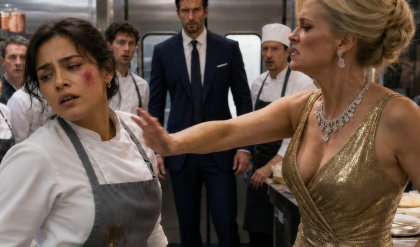
she stitched up a bleeding stranger at 2 a.m.; by sunrise, two hundred mafia men were surrounding her apartment
Nobody got out.
That was worse.I ran upstairs, locked my door, hooked the chain, and stood at my window.
Both SUVs sat at the curb.
I pulled the bills from my pocket.
Twenty-five hundred dollars.
Enough for rent.
Enough for groceries.
Enough to send my grandmother’s memory care facility the money I owed.
I set it on the coffee table like it was contaminated.
Then I slept badly and dreamed of ice-blue eyes.
A pounding on my door woke me at 4:37 p.m.
“Miss Shaw,” a man called. “Mr. Russo requires your assistance.”
Russo.
So now the bleeding stranger had a name.
I looked through the peephole. Another suit. Another expressionless face.
“I don’t know any Mr. Russo,” I said.
“You treated him last night.”
“Tell him to go to the hospital.”
A pause.
Then a black phone slid under my door.
I stared at it for three rings before picking it up.
“Emma.”
His voice crawled straight down my spine.
“Mr. Russo,” I said, trying to sound braver than I felt. “I don’t make house calls.”
“Yet here we are.”
“What do you want?”
“My wound is infected.”
“Then go to the hospital.”
“We both know I won’t.”
“Then call one of the doctors you clearly have hidden under rocks.”
“I trust your hands.”
I closed my eyes. “You don’t know me.”
“I know enough.”
“No, you investigated enough. That’s different.”
Silence.
He was breathing harder than before.
“How bad?” I asked, hating myself.
“Bad enough that my men are worried.”
That meant bad.
I looked at the money on my table. At the cracked paint on my walls. At the photograph of James I still couldn’t bring myself to put away.
“You’re putting my license at risk,” I said.
“I’m putting my life in your hands.”
That was how I ended up in the back of a black SUV, blindfolded, clutching my old medical bag like a weapon.
When they removed the blindfold, I was standing before a modern glass mansion somewhere north of the city, surrounded by pine trees, stone terraces, a private lake, and enough armed men to invade a small country.
Inside, wealth whispered from every wall. Not gold-plated, not vulgar. Worse. Tasteful. Museum art. Soft rugs. Dark wood. Silence so expensive it felt purchased.
They took me upstairs.
Salvatore Russo lay in a bed larger than my apartment, shirtless, sweating, his skin gray beneath the olive tone, my bandage soaked through with yellow discharge.
An older man with silver hair stood beside him.
“You’re the nurse?” he said, unimpressed.
“I’m the person who told him not to do anything stupid,” I said. “So apparently I’m also ignored.”
Russo’s mouth curved weakly. “Leave us.”
“Salvatore—” the older man began.
“Out.”
They obeyed.
I approached the bed. “You should be in a hospital.”
“You repeat yourself.”
“And you infect yourself. We all have hobbies.”
His eyes brightened despite the fever.
I peeled back the bandage and swore under my breath. The wound was angry, swollen, hot, and oozing. The infection had spread around the sutures.
“You tore something open,” I said.
“Business required my attention.”
“Business is going to kill you.”
“Many have tried.”
“Congratulations. Bacteria might succeed.”
That made him laugh, then wince hard enough that sweat broke across his forehead.
For the next hour, I removed the infected sutures, cleaned the wound, packed it with antibiotic gauze, started IV fluids, and gave him broad-spectrum antibiotics from supplies his men had somehow acquired with terrifying efficiency.
He endured all of it in silence.
Only once did his hand close around my wrist.
“You’ll stay,” he said.
“No.”
“Emma.”
I hated the way my name sounded in his mouth. Like an order pretending to be a prayer.
“I have a shift,” I said.
“Handled.”
“My apartment.”
“Watched.”
“My life.”
His grip softened. “Endangered.”
I looked at him.
For the first time, I saw something behind the control. Not fear. Salvatore Russo did not look like a man who had made room for fear.
But concern.
“Why?” I asked.
“Because someone followed you from the hospital. Because my enemies now know you treated me. Because you came here.”
“You brought me here.”
“Yes,” he said. “And now I will keep you alive.”
Part 2
By midnight, I understood two things.
First, Salvatore Russo was not just dangerous.
He was powerful in a way that made people lower their voices when they said his name.
Second, I was not a guest.
No matter what anyone called it.
The older man returned after Salvatore fell asleep from the sedative I gave him. He stood in the doorway, looking at his boss with a worry he tried to disguise as irritation.
“How is he?” he asked.
“Stable. Fever’s down a little. Infection is still serious.”
He nodded. “I’m Marco.”
“Emma.”
“I know.”
“Of course you do.”
A tired smile crossed his face. “You should understand where you are.”
“In a rich man’s house with too many guns.”
“In the lion’s mouth,” Marco said. “And you are standing very close to his teeth.”
I looked at Salvatore sleeping under charcoal sheets, his face softened by exhaustion. Without his cold eyes open, he looked younger. Still dangerous. Still beautiful in a way that annoyed me.
“I didn’t ask for this,” I said.
“No one ever asks for Salvator Russo.”
“Salvator?”
“His family name for him. He lets few people hear it.”
“I’m not honored.”
“You should be careful anyway.”
Marco moved closer, lowering his voice.
“His father was Antonio Russo. Old-school. Respected. Feared. When Salvatore was seventeen, a rival family sent killers to their home. They murdered his parents. He survived because he picked up his father’s gun and refused to die.”
My stomach tightened.
“After that,” Marco said, “he built something no one could take from him again.”
“An empire?”
“A fortress.”
I looked around the room.
Glass walls. Armed men. Locked gates. A wounded man who didn’t trust hospitals because vulnerability was more dangerous than infection.
“Sounds lonely,” I said.
Marco studied me. “That is the first intelligent thing anyone has said about him in years.”
In the morning, Salvatore was gone from the bed.
I found a note on the nightstand.
Emma,
Business required my attention.
Do not leave the grounds.
S.R.
I nearly crumpled it in my fist.
He had a fever. An open infected wound. An IV line I had started that now hung useless beside the bed.
And he had gone to work.
A young housekeeper named Sophia brought breakfast and clothes that fit me too well to be accidental. I showered in a bathroom the size of a boutique hotel suite and changed into jeans and a cream sweater with tags still on it.
The entire house felt like a place designed by someone who understood beauty but not peace.
I found Marco in a study, talking on the phone in Italian. He ended the call when I entered.
“I need to call Mercy General,” I said. “Tell them I can’t come in.”
“Already done.”
My skin prickled. “Excuse me?”
“Your supervisor believes you have the flu.”
“You called my job?”
“Salvatore handled it.”
“Of course he did.”
“He also paid your rent for six months and covered your grandmother’s care facility for the year.”
The room tilted.
I grabbed the back of a chair. “He had no right.”
“Salvatore pays his debts.”
“That’s not a debt. That’s a leash.”
Marco said nothing, which was worse than disagreement.
Later, he walked me through the grounds. The lake glittered under pale autumn light. Men patrolled in pairs along the tree line. Cameras moved quietly. The iron fence was at least ten feet tall with wiring along the top.
“How many men does he have?” I asked.
“Enough.”
“That’s not a number.”
“Today? More than usual.”
“Why?”
“An incident.”
Before I could press him, a convoy rolled through the gate.
Black SUVs. One after another. Men stepping out before the cars fully stopped.
Then Salvatore emerged.
Charcoal suit. Dark hair combed back. Face pale. Jaw tight with pain.
He looked like a man walking out of a war and refusing to admit he had been shot.
His eyes found me across the lawn.
My pulse betrayed me.
One hour later, Sophia escorted me to his private study.
Salvatore sat behind a massive desk, his face too calm, his skin too flushed.
“You should be in bed,” I said.
“Good afternoon to you too.”
“Open your shirt.”
His brows lifted.
“For medical reasons,” I snapped.
“Pity.”
I hated that my cheeks warmed.
I changed his bandage. The infection had not worsened, but the wound was still angry.
“You’re risking sepsis every time you play king in a suit,” I said.
“Some thrones require presence.”
“This isn’t a throne. It’s a desk.”
“All thrones are desks if the right men fear what is signed there.”
I stepped back. “I want to go home.”
His expression changed.
Not surprise. He had expected this.
“That is complicated.”
“No, it isn’t. You have a doctor. You have a housekeeper. You have Marco, the terrifying Italian uncle of death. You don’t need me.”
“I do.”
The simplicity of it hit harder than it should have.
Before I could answer, Marco entered without knocking.
“They found it,” he said.
Salvatore’s face went still. “Where?”
“In her medical bag.”
My breath stopped.
“What?” I whispered.
Marco set a small device on the desk.
A tracker.
“It activated shortly after she arrived,” Marco said. “They have been monitoring movement inside the house.”
Salvatore crossed the room so fast I barely saw him wince. His hands closed around my arms.
“Who touched your bag at the hospital?”
“I don’t know. I—”
Then I remembered.
“A new security guard,” I said. “He said they were checking staff bags because of a theft complaint.”
Marco swore.
Salvatore’s eyes turned glacial.
“The Costova family,” he said. “They used you to find my house.”
My mouth went dry. “They put a tracker on me before I even met you?”
“They knew I was wounded. They knew someone from the hospital might lead them to me.”
“So I was bait.”
“No,” Salvatore said.
“Yes.” I pulled away from him. “That’s exactly what I was. Bait for your enemies, prisoner for your protection, and debt for your conscience.”
His face hardened. “Watch your words.”
“Or what? You’ll surround my life with more men? Pay another bill? Buy another lock? Call it safety?”
Something flashed in his eyes. Anger, yes. But underneath it, pain.
“I am trying to keep you alive.”
“I was alive before you.”
“You were existing.”
The words hit too close.
I slapped him.
The sound cracked through the study.
Marco inhaled sharply.
Salvatore did not move.
My hand stung. My heart hammered. For one terrible second, no one breathed.
Then Salvatore slowly turned his face back to mine.
“You’re right,” he said quietly.
That frightened me more than rage would have.
“I had no right to pull you into my world and call it protection. But the danger is real. The Costovas know your name. Your apartment. Your hospital. If you leave unguarded, they will take you to get to me.”
I wanted to hate him.
I did hate him.
I also believed him.
“What happens now?” I asked.
“Tonight I meet Victor Costova.”
“Meet?”
“Negotiate.”
Marco gave me a look that said in their world, negotiate was just a clean word for a dirty thing.
“Absolutely not,” I said. “You can barely stand.”
Salvatore’s mouth curved. “Your concern is noted.”
“My professional opinion is that you are an arrogant idiot.”
“And your personal opinion?”
I stared at him. “Don’t die before I decide whether I hate you.”
For the first time all day, he smiled like something human had broken through the armor.
That night, the estate transformed.
Floodlights cut across the lawn. Men moved with tactical precision. Vehicles lined the drive. The air outside seemed to hum.
I stood at the upstairs window beside Marco.
“How many?” I asked.
“Here tonight?” he said. “Over two hundred.”
Two hundred men.
All because one bleeding stranger had walked into my ER.
“All for him?” I whispered.
Marco looked at me. “Tonight? For both of you.”
Salvatore left the house in a black coat over his suit, refusing my warning, refusing Marco’s, refusing common sense. He was gone for three hours.
When he returned near midnight, his face was pale and his shirt was dark with fresh blood beneath the jacket.
“Terms accepted,” he said.
Then he collapsed.
I caught him badly, my shoulder slamming into his chest as Marco grabbed his other side.
“You stupid, impossible man,” I snapped, my voice breaking. “Get him upstairs.”
In the master suite, I reopened the wound and found torn tissue, fresh bleeding, and fever climbing again. My hands moved automatically. Clean. Pack. Pressure. Antibiotics. Fluids. Orders barked at men who obeyed me because their boss was too weak to contradict me.
At some point, Salvatore opened his eyes.
“Emma.”
“Shut up.”
“Bossy.”
“Bleeding patients don’t get opinions.”
“Stay.”
My hands paused.
Not the command from before.
A request.
“Sleep,” I said. “I’ll be here.”
He reached for my wrist but didn’t have the strength to hold it.
I took his hand instead.
At dawn, when his fever finally broke, he told me about his parents.
Not like a confession. Like a wound he had never allowed anyone to clean.
He showed me a photograph: a teenage boy with pale eyes, standing between a stern father and a beautiful mother with one hand on his shoulder.
“They killed them in this house,” he said. “My father first. My mother on the stairs. I was seventeen.”
I looked at the staircase in my mind. The polished floors. The quiet luxury. The boy waiting with his father’s gun.
“Marco arrived before they could take me,” he said. “After that, I became what survived.”
“And did revenge fix anything?”
His eyes met mine.
“No.”
It was the first honest answer he had given me that did not come wrapped in power.
I touched the edge of the photograph.
“Then why keep living like this?”
“Because stopping is not simple.”
“No,” I said. “But neither is dying from an infected knife wound because you can’t let other men see you rest.”
A tired smile crossed his face. “You make everything sound foolish.”
“Some things are.”
He watched me for a long time.
“What do you want from me, Emma?”
I thought of James. Of blood on my hands. Of the woman I used to be before grief made my life small.
“The truth,” I said. “And my freedom.”
His expression closed.
Then opened, barely.
“You may go home today.”
I didn’t expect that.
“No blindfold,” he added. “No lies. Marco will take you. The men outside your apartment will stay until the Costova threat is ended. They will not interfere with your life.”
“And you?”
“I will wait.”
“For what?”
“For you to decide whether I am something you run from or something you face.”
Part 3
My apartment looked smaller when I returned.
The ceiling was still stained. The radiator still hissed like an angry cat. The kitchen faucet still dripped unless I turned it just right.
But the lock was new.
The windows had been reinforced.
A discreet security panel glowed beside my door.
Outside, one black SUV sat near the curb. Another waited at the corner.
Marco carried my medical bag up and handed me a cream envelope sealed with wax.
“From him,” he said.
I took it. “Does he always make everything feel like a scene from a nineteenth-century murder novel?”
Marco’s mouth twitched. “Usually there are fewer nurses insulting him.”
“Maybe that’s been his problem.”
“Maybe.”
He turned to leave, then paused.
“Miss Shaw.”
I looked up.
“Whatever he is, he is different with you.”
“That doesn’t make him safe.”
“No,” Marco said. “But it may make him reachable.”
Then he left me alone.
I opened the letter after ten minutes of staring at it like it might explode.
Emma,
By now you are home and likely angry. You have every right to be.
I have blood on my hands. I command men who fear me, enemies who hunt me, and a world that does not forgive weakness. I will not pretend I am a good man because you would see through the lie.
But with you, I remembered something I thought died when I was seventeen.
Not peace. I don’t know if men like me get peace.
But the desire to be better than what hurt me.
You asked for truth and freedom. You have both.
The men outside are there because danger remains, not because I doubt your will. You may send them away. You may call me. You may never see me again.
If you choose the last, I will still protect you until the threat is gone.
Not because you belong to me.
Because I owe my life to you.
Salvatore
I read the final line three times.
Not because you belong to me.
It should not have mattered.
It did.
I set the letter down and finally turned my phone back on. Messages poured in from work. Dr. Patel. Two friends I had ignored for months. The care facility in Baltimore.
One voicemail from my grandmother’s nurse made my breath catch.
“Hi, Emma. Just wanted you to know your grandmother had a good morning. She asked for you by name today.”
I sank onto the futon and cried harder than I had in months.
Maybe years.
Not because of Salvatore. Not because of fear.
Because for three days, my life had been terrifying and vivid, and now that I was home, I could see how silent I had let everything become.
That evening, I went to Mercy General.
The SUV followed at a distance. I hated it. I was grateful for it. Both truths sat inside me uncomfortably.
Dr. Patel looked up when I entered the nurses’ station.
“Shaw. You look terrible.”
“Good to see you too.”
“Flu?”
“Something like that.”
He studied me for a second, then nodded toward Curtain Two. “Stitches.”
“Of course.”
Work pulled me back by muscle memory. Gloves. Gauze. Vitals. Coffee. Pain. People needing help for reasons they could not afford and choices they could not undo.
At 9:40 p.m., a man in a security uniform walked through the ER entrance.
I recognized him instantly.
The fake guard.
The one who had checked my bag.
He saw me and smiled.
My blood turned cold.
I stepped back behind the desk and reached for the phone Salvatore had given me.
The fake guard lifted one hand, showing me he had nothing in it.
Then he mouthed two words.
Come outside.
I didn’t.
I called Salvatore.
He answered on the first ring.
“Emma?”
“He’s here,” I whispered. “The man who planted the tracker.”
His voice changed. “Where are you?”
“Mercy General.”
“Stay inside.”
The fake guard turned and walked out.
A minute later, my personal phone buzzed.
Unknown number.
A photo appeared on the screen.
My apartment door.
Then another.
My grandmother’s care facility in Baltimore.
Then a text.
No police. No Russo. Come alone or the old woman pays.
For a moment, I could not breathe.
Then training took over. When panic is too large, the body chooses tasks.
I forwarded the messages to Salvatore.
Then I called Marco.
Then I walked to the break room, locked the door, and threw up in the sink.
Salvatore called back.
“Emma, listen to me.”
“They know about my grandmother.”
“I have men already moving in Baltimore.”
“How?”
“Because I never stopped protecting all points of risk.”
I should have been angry.
I was too scared.
“I can’t let them hurt her,” I said.
“They won’t.”
“You don’t know that.”
His voice softened. “No. But I know what happens to men who threaten women under my protection.”
“Salvatore.”
“I’m coming.”
“No.” My voice surprised both of us. “That’s what they want. They want you wounded, angry, moving fast.”
Silence.
“You told me I had a choice,” I said. “Then let me make one.”
“What choice?”
“Use me.”
“No.”
“They want me alone? Fine. We give them what they want. But not your way.”
“My way keeps you alive.”
“Your way starts wars.”
He said nothing.
I pressed my hand against the break room door and lowered my voice.
“I am not asking you to be weak. I am asking you to be smarter than men who only know how to bleed.”
The silence stretched so long I thought the call had dropped.
Then he said, “Tell me your plan, Nurse Shaw.”
One hour later, I walked out of Mercy General alone.
At least, that was what it looked like.
The street was wet from a sudden rain. Taxis hissed through puddles. Steam rose from a manhole cover like the city was breathing.
I wore my coat, my sneakers, and a wire under my collar.
My hands shook.
This time, I let them.
A gray van waited near the curb.
The side door opened.
The fake guard sat inside, flanked by two men.
“Phone,” he said.
I handed him the burner.
He smashed it beneath his boot.
“Get in.”
I climbed into the van.
One of the men patted me down. He missed the second wire sewn into the lining of my coat because my grandmother had taught me to sew before I could write my name.
They drove for twenty minutes, maybe less. Long enough for me to think about James. Long enough to wonder whether this was courage or stupidity. Long enough to hear Salvatore’s voice in my memory telling me there was always a choice.
They took me to my own apartment building.
At first, I didn’t understand.
Then I saw the lights.
Men stood on rooftops. In alleys. Behind parked cars. At both ends of the block.
Not Salvatore’s men.
Costova’s.
My building had become the trap.
Inside my apartment, Victor Costova waited in my chair, a heavyset man in a navy suit with cruel eyes and a smile that belonged nowhere near a human face.
“Emma Shaw,” he said. “The nurse who made Salvatore Russo careless.”
“I think he was careless before me.”
Victor laughed. “Sit.”
I sat.
He leaned forward. “You will call him from your phone. You will tell him you are alone. Cry if you can. Men like Russo enjoy rescuing beautiful broken things.”
I looked at my coffee table. At Salvatore’s letter still lying there.
Not because you belong to me.
“No,” I said.
Victor’s smile faded.
“No?”
“No.”
He stood and struck me across the face.
Pain flashed white. My mouth filled with blood.
I turned back slowly.
“I’m a nurse,” I said. “I’ve been hit by men better than you and treated men worse than you. You’re not impressive.”
His eyes went flat. He reached into his jacket.
That was when the building shook.
Not from an explosion.
From footsteps.
Heavy. Synchronized. Everywhere.
Victor froze.
Outside, car doors slammed. Dozens. Then more. Radios crackled. Men shouted in Italian and English. Boots thundered up the stairs, down the fire escape, across the roof.
One of Victor’s men ran to the window.
His face drained.
“Boss,” he whispered.
Victor grabbed my arm and dragged me up. “What did you do?”
I looked him in the eye.
“I made a house call.”
The door blew open.
Marco entered first.
Behind him came men in black.
And behind them, pale but upright, one hand pressed discreetly to his injured side, came Salvatore Russo.
He looked at my bleeding lip.
The temperature in the room seemed to drop.
“Take your hand off her,” he said.
Victor pressed a gun to my ribs. “One more step and she dies.”
Salvatore stopped.
For the first time since I had met him, I saw real fear cross his face.
Not for himself.
For me.
“Emma,” he said softly.
I knew what he was asking.
I also knew what he was afraid of becoming if I died in that room.
So I did the only thing I could.
I reached down, grabbed the fresh dressing scissors hidden in my coat sleeve, and drove them into Victor Costova’s hand.
He screamed.
I dropped.
The gun went off above me, shattering the window.
Then the room became motion.
Marco dragged me behind the couch. Salvatore’s men flooded the apartment. Victor hit the floor under three bodies. Someone shouted for medical. Someone else shouted clear. Glass glittered on the rug like ice.
Salvatore reached me on one knee.
“Emma.”
“I’m fine,” I said, though my voice shook.
“You’re bleeding.”
“You’re bleeding worse.”
He laughed once, broken and breathless, then touched my face with a tenderness so careful it hurt more than the slap had.
“You terrified me,” he whispered.
“Good,” I said. “Now you know how everyone feels around you.”
His eyes closed for half a second.
Then he opened them and looked around my ruined apartment, at the guns, the men, the blood, the letter on the table.
When he spoke again, his voice was different.
Not softer.
Clearer.
“Marco.”
“Yes?”
“No bodies.”
Marco stared at him.
Salvatore kept his eyes on me. “Call federal contacts. Call the prosecutors we have leverage with. Costova lives. His men live. They answer in court.”
Victor, bleeding and pinned to the floor, began to laugh. “You think court saves you? You think she made you clean?”
Salvatore stood slowly, pain tightening his mouth.
“No,” he said. “She reminded me I still have a choice.”
By dawn, Victor Costova was in federal custody. So were eight of his men. So was the fake guard from Mercy General.
I gave a statement with Marco’s lawyer present, then another without him, because some truths needed to belong to me.
Salvatore waited outside the precinct in a black coat, pale and exhausted, looking less like a king than a man who had finally understood the cost of his crown.
“You should go to the hospital,” I said.
“I know.”
I blinked. “Did you just agree with me?”
“Don’t get used to it.”
At Mercy General, Dr. Patel nearly dropped his coffee when Salvatore Russo walked in voluntarily and asked for a doctor.
I stood beside him while they admitted him.
Not as his prisoner.
Not as his property.
As the woman who had saved him twice and refused to let him confuse protection with ownership ever again.
Weeks passed.
Victor Costova’s case made headlines, though Salvatore’s name appeared only in whispers. My grandmother was moved to a better facility in Baltimore, one I chose and paid for with a scholarship fund Salvatore created in James’s name after asking permission first.
That mattered.
He also funded a free clinic near Mercy General.
That mattered more.
He did not become a saint. Men like Salvatore Russo did not transform overnight into something harmless. But he began moving pieces of his empire into the light. Real businesses. Legal ones. Painfully slow, dangerously complicated, but real.
And every time he tried to make a decision for me, I raised one eyebrow and waited.
He learned.
One evening, months later, I found him at the clinic ribbon-cutting, standing awkwardly beside a wall painted soft blue. Children ran past him. Nurses laughed. A little boy offered him a sticker shaped like a dinosaur.
Salvatore looked at it like it was a bomb.
“Take it,” I said.
He did.
The boy stuck it to his expensive suit jacket and ran away.
I laughed so hard I nearly cried.
Salvatore looked down at the sticker, then at me. “This is your fault.”
“Most good things are.”
His expression softened.
Outside, there were no black SUVs crowding the block. No army of men surrounding the doors. Just ordinary traffic, ordinary noise, ordinary life.
He took my hand.
“Do you regret it?” he asked.
“Saving you?”
“Choosing this.”
I looked at the clinic. At the nurses moving through bright rooms. At Salvatore standing in the doorway between shadow and light, still scarred, still dangerous, but trying.
“No,” I said. “But I didn’t choose your world.”
His fingers tightened around mine.
“I know.”
“I chose the man who decided he didn’t have to stay buried in it.”
For a long moment, he said nothing.
Then Salvatore Russo, the man who once commanded two hundred men to surround my apartment, bowed his head and pressed his lips to my hand like it was something sacred.
Three months earlier, I had stitched up a stranger in Curtain Four and thought I was only closing a wound.
I didn’t know I was opening a door.
I didn’t know blood could lead to mercy.
I didn’t know the most dangerous man I would ever meet would also be the one who reminded me I was still alive.
But that was the thing about emergency rooms, grief, and broken people.
Sometimes the heart stopped in one life only to start beating in another.
THE END